Idaho Teacher Refuses to Remove “Everyone Is Welcome Here” Sign, Defying School District Order
- Thomas Nelson
- July 16, 2025
- Uncategorized
- 0 Comments
In a small Idaho classroom, a big question is being asked: Should welcoming students be considered controversial?
Sarah Inama, a sixth-grade history teacher at Lewis and Clark Middle School in Meridian, is challenging her district’s directive to remove two posters from her classroom walls. One reads, “Everyone is welcome here,” accompanied by artwork of hands in various skin tones. The other states that students in her class are “welcome, important, accepted, respected, encouraged, valued, and equal.”
Inama has refused to take them down.
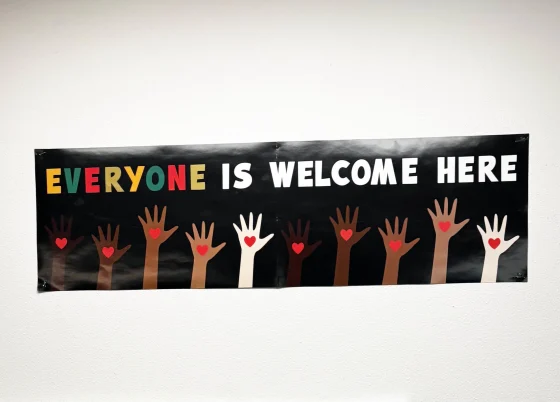
“I was just so confused,” she told TODAY.com in an interview published on March 14. “I still can’t even wrap my head around what they’re referring to as far as why it’s controversial.”
According to Inama, the controversy began in January when both her principal and vice principal informed her the posters violated district policy requiring classroom decorations to be “content-neutral” and respectful of differing opinions. In an email to TODAY.com, the West Ada School District confirmed that the request was made under Policy 401.20, which limits classroom signage to materials that are educational in nature and unlikely to cause disagreement or distraction.
But to Inama, asking her to remove a poster that says everyone is welcome doesn’t feel neutral at all.
“There are only two opinions on this sign: Either everyone is welcome here, or not everyone is welcome here,” she told TODAY.com. “Since the sign emphasizes that everyone, in regards to race or skin tone, is welcome here no matter what… the only other view of this is racist.”
Initially, she complied. But over the weekend, she says, the decision haunted her.
“I told my husband, ‘I have to put that sign back up,’” she recalled.
She returned to her classroom, re-hung the signs, and sent an email to her principal explaining her decision. She says she was promptly warned that her refusal to remove the posters could be considered insubordination and result in disciplinary action.
The standoff escalated. Inama met with the district’s chief academic officer, Marcus Myers, as well as a representative from the West Ada Education Association. In the meeting, officials suggested she could choose alternative motivational posters—just not ones with the same wording.
Inama challenged the request. She pointed to the district’s own classification of motivational posters as learning aids, arguing that hers should be permitted. According to her, Myers responded by citing political shifts and public sensitivity: “The political environment ebbs and flows, and what might be controversial now might not have been three, six, nine months ago,” he said, as reported by TODAY.com.
The conversation left Inama more convinced than ever that removing the signs would compromise her values.
“The more that we talked about it, the more it just solidified,” she said. “It seems so gross what they’re asking me to compromise about.”
After submitting a lengthy email defending her position, the district responded a week later. According to Inama, legal counsel upheld the original ruling: the posters must come down by the end of the school year.
In a written statement to TODAY.com, district spokesperson Niki Scheppers said the policy is not about limiting free expression, but about keeping classrooms consistent and free from distractions.
“While classroom decorations can contribute to the atmosphere, a truly welcoming and supportive environment is built through meaningful relationships and positive interactions between staff and students, not posters on the walls,” Scheppers wrote.
According to the district, approved classroom decorations include state and national flags, instructional materials like the periodic table or Constitution, student work, and school-related achievements. The policy also allows personal family photos, college banners, and sports team memorabilia—but not posters deemed political or “non-neutral.”
To Inama, those boundaries feel arbitrary. More importantly, they feel harmful.
“I would feel so sad to leave my students before the end of the year,” she said, acknowledging that losing her job would come with serious financial strain. “But there’s no way I would be able to allow myself to just take it down and roll over to what I feel like they’re asking me to do.”
In the weeks since her story gained media attention, Inama says she’s received hundreds of messages of support—from colleagues, parents, and even strangers. Many of them, she says, are teachers who have faced similar pressure in their own classrooms.
Inama’s resistance is not just about a sign. It’s about the values behind it: inclusion, safety, and dignity for every student. For her, those ideas are not up for negotiation.
“I’m not interested in compliance for the sake of comfort,” she said. “This is about the kind of space I want my students to grow in. And I’m going to protect that.”