The Best Plants for Hummingbirds: Native Species That Actually Work
- Give A Shit About Nature
- May 11, 2026
- Backyard Habitat, Native Plants, Wildlife
- 0 Comments
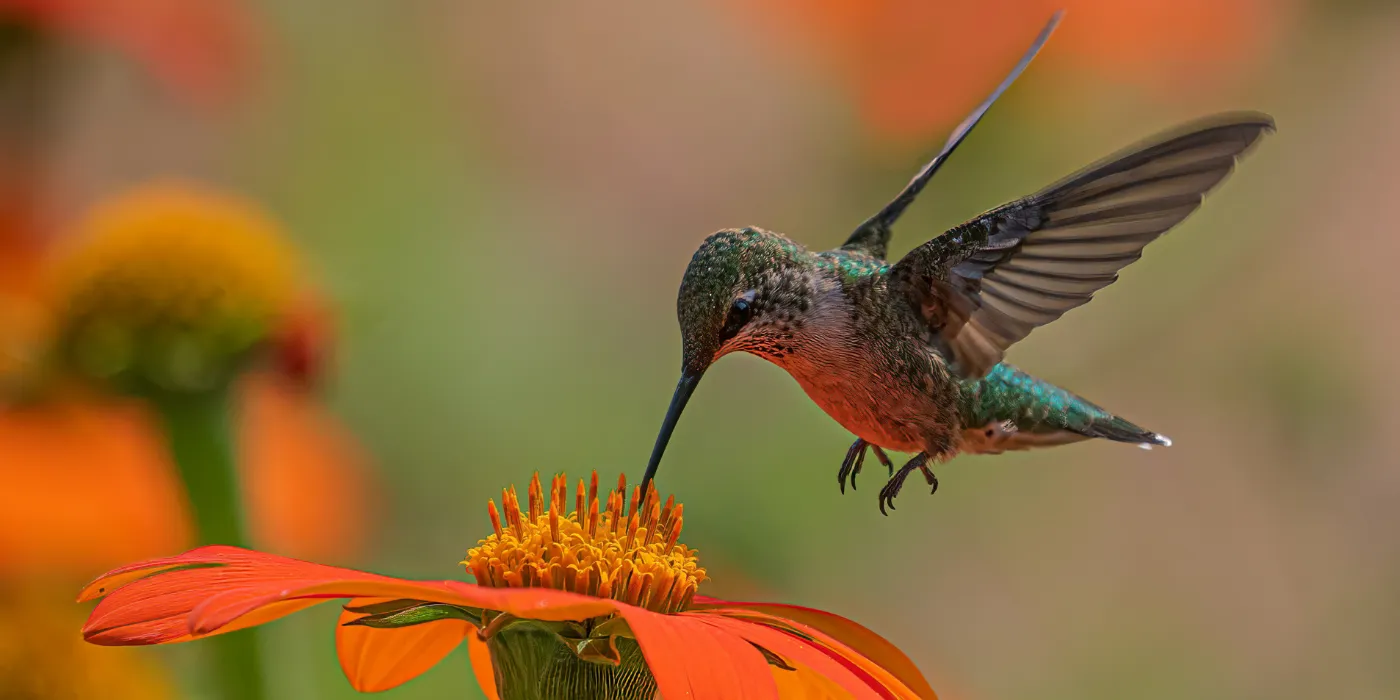
Before the plant list, one thing worth saying: hummingbirds spend the overwhelming majority of their time hunting insects, not visiting flowers. Nectar is energy. Insects are protein, fat, and calcium — everything they need to raise young and survive migration. A garden that feeds hummingbirds well does both, which is why native plants outperform non-native ornamentals even when both produce nectar. Native plants support the insect communities hummingbirds depend on in ways that non-natives typically don’t.
The other thing worth saying: the color red is not actually required. Hummingbirds learn which flowers are nectar-rich regardless of color. Red shows up often on this list because many high-nectar native plants happen to be red, not because hummingbirds literally can’t see other colors.
With that established, here’s what to plant.
Cardinal Flower (Lobelia cardinalis)
If there’s one plant that appears on every credible hummingbird list from every reputable source, it’s this one. Cardinal flower produces vivid scarlet spires on tall stems, blooms in late summer when hummingbird migration is underway, and produces nectar at sugar concentrations around 25-30% — genuinely rich by flower standards. It also grows in consistently moist or even wet soil, which makes it a useful choice for low spots or rain garden edges where other plants struggle.
It’s a short-lived perennial that self-seeds readily, so once you have it, you tend to keep it. Virginia Department of Forestry lists it as one of the core natives for hummingbird habitat, tolerating both sun and shade as long as roots stay moist.
Coral Honeysuckle (Lonicera sempervirens)
This vine does something most plants can’t: it blooms from late spring into fall, providing nectar across an unusually long window. The clusters of narrow red-orange tubes are sized almost precisely for a hummingbird bill. Unlike Japanese honeysuckle, which most gardeners know as the aggressive vine that takes over everything, coral honeysuckle grows vigorously but stays where you put it. It works beautifully on fences, arbors, or mailboxes, adding wildlife value to surfaces that would otherwise just be structure.
It also provides nesting cover. A vine with flowers and dense foliage is genuinely more valuable to hummingbirds than a simple nectar source, since they need shelter too.
Bee Balm (Monarda didyma)
Bee balm earns its spot through sheer exuberance — the pom-pom flowers in red and fuchsia produce generous nectar and bloom repeatedly through midsummer if you deadhead spent flowers. It handles partial shade well, which gives it an advantage over strictly sun-loving species in gardens with mixed light. The downside is powdery mildew, which bee balm is prone to in humid conditions. Spacing plants 18 to 24 inches apart and watering at the base rather than overhead helps considerably.
The red-flowered Monarda didyma is the one hummingbirds favor most, though all bee balm species attract them. It also supports a remarkable diversity of native bees and butterflies, which makes it one of the higher-value plants you can add to any garden bed.
Native Columbine (Aquilegia canadensis)
Timing is what makes columbine invaluable. It blooms in early spring, often before most other hummingbird plants have leafed out, and its hollow nectar spurs are almost impossibly well-matched to a hummingbird’s bill length. Ruby-throated hummingbirds migrating north in April and May are arriving to a landscape that hasn’t fully woken up yet, and columbine is one of the few natives that meets them with food.
It handles partial shade easily, self-seeds freely, and is deer-resistant. Once established, you’ll find it appearing in new spots around the garden on its own.
Native Salvias (Salvia spp.)
Salvia is a big genus, and several native species are exceptional hummingbird plants. Scarlet sage (Salvia coccinea) works across much of the South and Southeast. Pitcher sage (Salvia azurea) is a tall, blue-flowered species for the Midwest and central regions. Texas sage (Salvia greggii) is drought-tolerant and widely used in the Southwest. The common thread is a tubular flower that hummingbirds probe readily and abundant nectar production over a long season.
The diversity of the genus means there’s nearly always a native salvia that fits your region and growing conditions, which makes it worth researching which species are native where you are before buying.
Trumpet Vine (Campsis radicans)
Here’s the complicated one. Trumpet vine produces some of the most hummingbird-visited flowers of any native plant — large, orange-red trumpets that look designed for the job because, ecologically, they kind of were. But trumpet vine spreads aggressively through root suckers and can become a serious management headache if you plant it in the wrong spot or don’t keep up with it.
It’s worth including for people who have a structure it can grow on, adequate space, and the willingness to cut it back. On a pergola or a fence well away from buildings, it’s stunning and produces months of hummingbird activity. Against a house foundation or near a garden with soft plants, it will eventually cause problems.
Penstemon (Penstemon spp.)
Penstemons are tubular-flowered, often red or pink, and native across much of North America — there are species appropriate for almost every region and soil type. Firecracker penstemon (Penstemon eatonii) is a standby in the West. Eastern native penstemons like Penstemon digitalis and Penstemon laevigatus work well across much of the eastern U.S.
They tend to be drought-tolerant once established, bloom in late spring and early summer when early migrants are active, and hold nectar deep in funnel-shaped corollas where hummingbirds are efficient and most other insects aren’t. Penstemon holds nectar for roughly four weeks of peak bloom, making it a reliable mid-season source.
Native Azaleas (Rhododendron spp.)
Often overlooked in hummingbird plant discussions because people are used to thinking of azaleas as Asian ornamentals, native azaleas are genuinely excellent early-season sources. Pinxter flower (Rhododendron periclymenoides) and flame azalea (Rhododendron calendulaceum) bloom when hummingbirds are arriving in spring and few other native plants have opened. Virginia Department of Forestry specifically notes that native azaleas feed the earliest hummingbird migrants on their way north from wintering grounds.
They’re shrubs rather than perennials, so they require a bit more space and a longer establishment period, but they’re long-lived and rewarding once in place.
Fire Pink (Silene virginica)
A smaller plant than most on this list, fire pink produces brilliant scarlet star-shaped flowers in early spring on wiry stems. It’s shade-tolerant, works well under open canopy, and provides early nectar at a moment when other options are limited. It tends to be biennial or short-lived, but self-seeds enough to maintain a presence in the garden once established.
It’s not always easy to find at mainstream nurseries, so you may need to seek out a local native plant sale or specialty grower. Worth the effort for the early-season coverage it provides.
A Note on Feeders
We’ve written before about when to put out hummingbird feeders and the maintenance they require. Feeders are a reasonable supplement, but a garden with a diverse set of native plants blooming from early spring through fall provides something a feeder can’t: habitat. Perching spots, nesting material, insects for protein, and a reason for hummingbirds to actually stay rather than stop briefly and move on.
If you’re choosing between a feeder and one good native plant, the plant wins.