Bug Zappers Don’t Kill Mosquitoes. They Kill Everything Else
- Give A Shit About Nature
- April 15, 2026
- Backyard Habitat
- 0 Comments
Bug zappers are one of the most widely sold pest control products in the United States. They are also, according to decades of entomological research, almost completely ineffective at killing the insects people buy them to kill — while being extremely effective at killing the insects people need most.
This isn’t a fringe position. It’s the consensus of the American Mosquito Control Association, Colorado State University Extension, and every entomologist who has studied these devices in field conditions. The gap between what bug zappers are marketed to do and what they actually do is one of the most well-documented mismatches in consumer pest control.
How bug zappers work
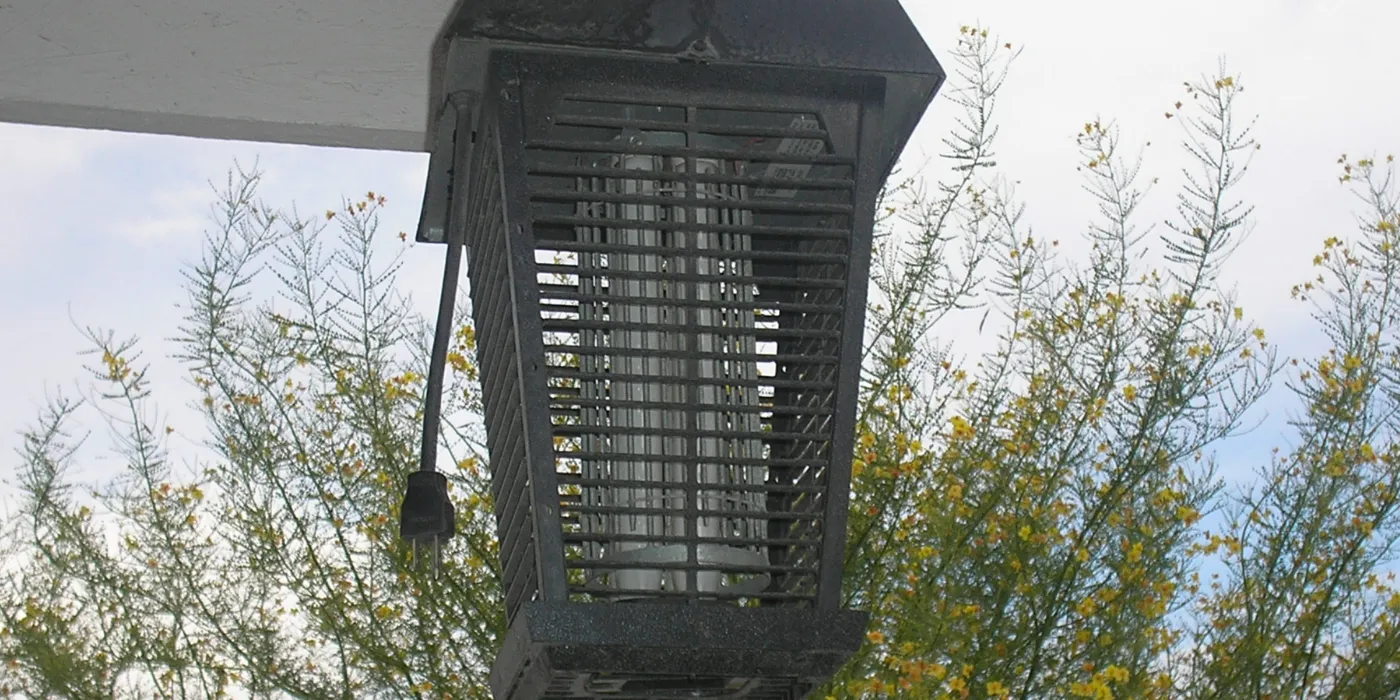
A bug zapper emits ultraviolet light, which attracts insects that navigate using light at night. Flying insects approach the device, make contact with an electrified grid, and are killed.
The mechanism is simple and genuinely effective at one thing: killing flying insects that are attracted to UV light.
The problem is that mosquitoes are not meaningfully attracted to UV light. They locate hosts using carbon dioxide, body heat, and specific chemical compounds in sweat. A glowing purple light has essentially no pull on a mosquito searching for a blood meal.
Many other insects, however, are strongly attracted to UV light — including nearly every ecologically valuable nocturnal insect species in your yard.
What the research actually shows
In one of the most cited studies on this subject, the Department of Entomology and Applied Ecology at the University of Delaware ran six residential bug zappers for 10 weeks and collected everything killed. The total: 13,789 insects.
Of those, 31 — 0.22 percent — were biting insects like mosquitoes or gnats.
The other 99.78 percent were non-target species. Most were beneficial beetles, moths, midges, parasitic wasps, and other insects that serve critical ecological functions.
Both the American Mosquito Control Association and Colorado State University Extension reviewed the evidence and reached the same conclusion: bug zappers have no meaningful effect on biting mosquito populations.
Meanwhile, that same device running through a summer kills thousands of insects that were doing genuine work in the local ecosystem — for zero mosquito control benefit.
Who actually gets killed
This is the part that matters most for anyone who cares about their garden, their birds, or their yard as habitat.
Moths. Moths are among the primary victims of bug zappers, and their loss ripples through the food web in ways that aren’t immediately obvious. Like bees and butterflies, moths are critical pollinators — particularly for night-blooming plants that bees never visit. Many plant species are pollinated exclusively or primarily by moths.
Beyond pollination, moth caterpillars are one of the most important food sources for nesting birds. Native plants matter for pollinators, roughly 96 percent of terrestrial birds raise their young on caterpillars. Moths produce far more caterpillar biomass than butterflies do. Killing adult moths reduces next season’s caterpillar population and with it the food supply for birds.
A 2018 review in Ecology and Evolution documented five categories of harm that artificial light at night causes to nocturnal insects — including behavioral disruption, reproductive interference, and direct mortality — and identified moths as among the most vulnerable taxa.
Parasitic wasps and predatory beetles. Many of the beetles and wasps killed by bug zappers are natural predators or parasites of common garden pests. Parasitic braconid wasps lay their eggs inside caterpillars and aphids, controlling pest populations without any chemical input. Ground beetles eat slug eggs, fly larvae, and other soil-dwelling pests. These are the insects doing quiet pest control work in your garden — and they’re being systematically eliminated by the device supposedly installed to reduce pests.
Lacewings. Adult lacewings are nocturnal and strongly attracted to UV light. Their larvae are voracious predators of aphids, thrips, and mealybugs — some of the most damaging soft-bodied garden pests. Killing adult lacewings removes a free, chemical-free pest management system that would otherwise have operated all season.
Fireflies. Fireflies are beetles, and they fly at night, which puts them squarely in the kill zone of any UV light trap. Firefly firefly populations have declined significantly due to light pollution and habitat loss. A bug zapper harms fireflies in two ways: direct electrocution, and by introducing artificial light that disrupts the bioluminescent mating signals fireflies depend on to find each other.
A 2022 review in Frontiers in Ecology and Evolution documented how artificial light at night specifically impairs firefly courtship signaling, reducing mating success and contributing to population decline.
The pattern across all of these is consistent: the insects most attracted to UV light are overwhelmingly the insects most valuable to a healthy yard. The insects people actually want to reduce — mosquitoes, biting flies — use entirely different navigation systems and are essentially unaffected.
The bacteria problem
There’s a separate issue with bug zappers that gets less attention but has been documented by researchers at Kansas State University in work presented at the American Society for Microbiology.
When an insect is electrocuted, the heat causes it to partially explode, launching a mist of insect particles — including bacteria and viruses present on the insect’s body surface — into the surrounding air. The Kansas State researchers found these particles can travel up to six to eight feet from the device.
The heat generated by the electrocution is not sufficient to sterilize those particles. Surface bacteria survive and become airborne.
The researchers explicitly recommended that bug zappers not be used near food preparation areas, near areas where children play, or in any setting where spread of insect-borne microorganisms is a concern. This is a meaningful practical limitation for a device most people hang directly over a patio, deck, or outdoor dining area.
Why they stay popular despite the evidence
The research consensus on bug zappers has been clear for thirty years. The University of Delaware study was published in 1994. The Kansas State bacteria research was presented in 1999. The American Mosquito Control Association’s position has been consistent for decades.
And yet bug zappers remain a massive industry.
Part of the explanation is psychological. The satisfying snap of electrocution provides immediate audible feedback — it sounds like the device is working. The fact that what’s being killed isn’t mosquitoes isn’t visible in the moment. Dead moths and beetles accumulate in a collection tray that most people empty without examining.
Part of it is that the absence of mosquito bites can feel correlated with having the zapper running, even when the actual driver is something else — wind direction, time of day, nearby standing water, or simply that mosquito populations vary night to night.
And part of it is that the marketing is loud and the counter-evidence requires looking past it.
What actually works against mosquitoes
If you’re using a bug zapper for mosquito control, the device is not solving your problem. Here’s what the evidence supports instead.
Eliminate standing water. Mosquitoes breed in standing water — flower pot saucers, clogged gutters, birdbath water that isn’t refreshed, low spots in the yard. Eliminating or cycling standing water addresses the source of the population rather than ineffectively targeting adults. A container as small as a bottle cap holds enough water for mosquito larvae to develop.
Bti dunks in water features. Bacillus thuringiensis israelensis is a naturally occurring soil bacterium that kills mosquito larvae specifically, without harming other aquatic insects, birds, or mammals. Available as “mosquito dunks” at most garden centers, a single dunk placed in a pond, rain barrel, or other standing water treats it for 30 days. If you have a water feature you can’t drain — or one you want to keep for wildlife — this is the most effective single intervention available.
Fans. Mosquitoes are weak fliers. A box fan directed toward a seating area creates airflow that mosquitoes cannot navigate effectively, keeping them away from people without killing anything. Inexpensive, immediate, and with zero ecological impact.
Bats and birds. Supporting the natural predators of mosquitoes is a longer-term strategy but a real one. A single bat can consume hundreds of mosquitoes per hour. Purple martin colonies are famous mosquito hunters. Supporting bat habitat — including bat houses and the native plant communities that support the insects bats eat — contributes to meaningful population-level reduction over time. Our articles on building a pollinator highway and rewilding your yard both describe habitat approaches that support the broader insectivorous animal community.
CO2-based traps. Unlike UV light traps, mosquito-specific traps that emit carbon dioxide and heat actually do attract mosquitoes, because those are the cues mosquitoes use to find hosts. These devices are significantly more expensive than bug zappers but significantly more effective at specifically targeting the insect people want to reduce. They’re most practical for larger properties or areas with consistently high mosquito pressure.
For a deeper look at what actually reduces mosquito populations around the yard, including which natural control methods have evidence behind them, our article on natural mosquito control covers the full picture.
What to do instead of a bug zapper
If you have a bug zapper and want to replace it with something more effective and less ecologically damaging, the clearest swap is: eliminate breeding sites, run a fan when you’re sitting outside, and let your yard’s natural insectivorous community — bats, swallows, predatory insects — do the longer-term work.
If part of the appeal is having light on the porch at night, consider switching to warm-yellow LED bulbs rather than white or blue-spectrum lights. Yellow and amber light is significantly less attractive to nocturnal insects than cool-white or UV-heavy light, meaning your porch light becomes far less of an insect trap while still providing illumination.
This is also one of the simplest things you can do for firefly populations and the broader nocturnal insect community that moths belong to — just changing the color temperature of your outdoor lights reduces the ecological footprint of illumination significantly.
Frequently asked questions
Do bug zappers kill mosquitoes at all? Rarely and negligibly. The University of Delaware’s 10-week field study found mosquitoes comprised 0.22% of insects killed. The American Mosquito Control Association’s position is that bug zappers are not effective for mosquito control.
What do bug zappers mostly kill? Primarily moths, beetles, midges, parasitic wasps, and lacewings — nocturnal insects attracted to UV light. The majority are ecologically beneficial species that pollinate plants, control pests, or serve as food for birds and bats.
Are bug zappers safe to use near food? No. Kansas State University researchers found that electrocuted insects produce an airborne mist of particles including viable bacteria that can travel up to six to eight feet. They specifically recommended against use near food preparation or eating areas.
Can you use a bug zapper indoors? Not recommended. Indoors, the bacteria dispersal issue is more concentrated, the beneficial insect kill is wasted, and there’s still no meaningful effect on mosquitoes, which find hosts by CO2 and body heat rather than light.
Will a bug zapper kill wasps, gnats, or flies? It will kill some, but inefficiently relative to what else it kills. For flies specifically, the same bacteria dispersal concern applies — a fly zapped near food is potentially worse than a fly swatted and removed. Gnats that are attracted to light will be caught; biting gnats that use CO2 navigation will not.
Do bug zappers hurt fireflies? Yes, directly through electrocution, and indirectly through the light pollution that disrupts their mating signals. If fireflies are present or desired in your yard, a bug zapper is counterproductive.
What’s the most effective single thing you can do to reduce mosquitoes? Eliminate standing water within 100 feet of where you spend time outside. Mosquitoes breed prolifically in small amounts of standing water and don’t travel far from their breeding sites. Removing those sites reduces the local population at the source more effectively than any trap targeting adults.