A bluebird nest box is one of the most popular wildlife purchases in the backyard birding world. It’s also one of the most frequently installed and then quietly ignored as year after year nothing moves in.
The box itself usually isn’t the problem. The habitat is.
Understanding what bluebirds actually need — and what commonly goes wrong — is the difference between a box that collects cobwebs and one that hosts two or three broods a season.
A quick history worth knowing
The eastern bluebird was once as common as the American robin across North America. By the mid-20th century, its population had fallen by an estimated 90 percent. The cause was a combination of habitat loss and fierce competition from two non-native cavity-nesting species — house sparrows and European starlings — that were spreading rapidly across the continent and outcompeting bluebirds for the tree cavities they depended on.
The recovery that followed is one of conservation’s genuine success stories, driven almost entirely by citizen volunteers who installed thousands of nest boxes designed with entrance holes too small for starlings to use. The North American Bluebird Society was founded in 1978 specifically to coordinate the effort. Eastern bluebird populations have increased steadily since the 1970s. In 2025, the Bluebird Recovery Program of Minnesota dropped “recovery” from its name — the population had recovered.
That history matters because it shows what nest boxes can accomplish when properly placed and managed. It also explains why so much detailed guidance exists on exactly how to do this right.
The reason most boxes go empty: habitat first
Bluebirds are insectivores that hunt by perching on a low vantage point — a fence post, a low branch, a utility wire — scanning open ground below them, and dropping down to catch prey. They need two things to do this: open, grassy foraging area with short vegetation, and perching structure at its edges.
A nest box installed in a wooded yard, near dense shrubs, in deep shade, or surrounded by tall grass will rarely attract bluebirds regardless of how well-built it is. As the North American Bluebird Society and virtually every extension program that has studied this emphasize: habitat is the single most important factor determining whether a box gets used.
The ideal setting is an open lawn or meadow with short grass, bordered by trees or fencing that provides perching structure, with the box mounted 15 to 30 meters from any tree line or woodland edge. Golf courses, cemeteries, farm fields, school grounds, and large suburban lots with open turf all fit this profile. A heavily planted suburban backyard with dense ornamental shrubs typically does not — unless there’s enough open lawn area to support foraging.
If you don’t have this habitat, a nest box won’t create it. Bluebirds will simply not settle somewhere that can’t support them.
Stop using pesticides
This is the second most common reason boxes go empty even in suitable-looking habitat, and it’s rarely mentioned in the how-to guides.
Bluebirds feed almost exclusively on insects during the breeding season — grasshoppers, beetles, caterpillars, crickets, spiders — and raise their young entirely on them. A yard or lawn treated with insecticides doesn’t just reduce pest insects. It depletes the entire invertebrate community bluebirds depend on to feed a brood. Even “lawn-safe” products labeled for grubs and surface insects reduce the prey base.
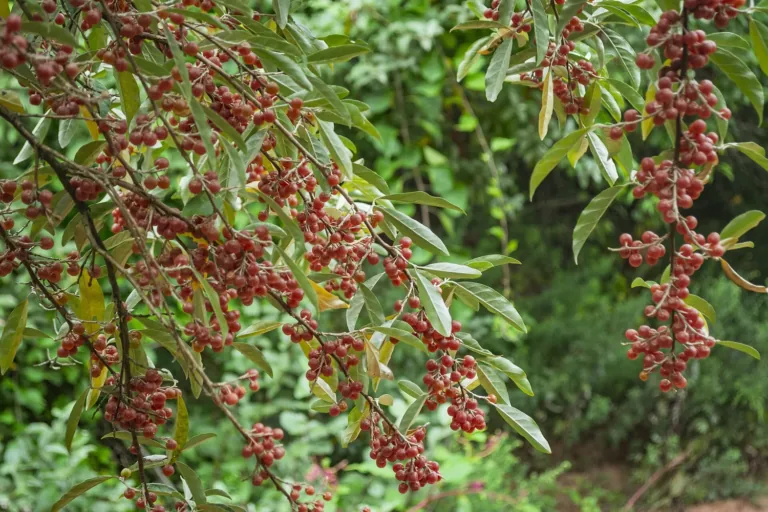
This connects to the broader principle that native plants support far more insect diversity than maintained turf or ornamental plantings. A lawn with some native plantings at its edges — keystone species like oaks and native flowering plants that support insect populations — provides a richer prey base than a chemically maintained monoculture. Bluebirds also benefit from the berry-producing native shrubs like serviceberry, dogwood, and native hollies that provide winter food when insects aren’t available.
The serviceberry in particular is one of the best dual-purpose plants for attracting bluebirds: it supports the insect community they forage on during breeding season and provides nutritious berries through fall and winter.
Box specifications that actually matter
Once habitat and food are addressed, the box itself needs to be right. Most commercial bird houses sold as “bluebird boxes” in garden centers are wrong in at least one critical dimension — usually too small a floor, too large an entrance hole, or a perch attached below the entrance.
The North American Bluebird Society’s recommendations are specific:
Floor size: 4 x 4 inches minimum for eastern bluebirds (5 x 5 for western and mountain bluebirds). Too small a floor cramps the nest and stresses nesting birds.
Entrance hole: 1½ inches diameter for eastern bluebirds, 1⁹⁄₁₆ inches for mountain bluebirds. This is the dimension that excludes European starlings while allowing bluebirds to pass freely. Too large and starlings move in; too small and bluebirds can’t enter.
No perch. This is counterintuitive but important. Bluebirds don’t need perches — their feet are adapted to gripping wood. An exterior perch primarily benefits house sparrows, which are more likely to claim a box that has one.
Material: Untreated, unpainted wood (cedar, pine, or exterior plywood) is best. Avoid decorative painted boxes, metal, and plastic, which overheat in summer. Light-colored exterior paint if used.
Drainage and ventilation: The floor should have drainage holes. Vent gaps near the top help prevent overheating in summer.
Depth: The floor should be at least 5 to 6 inches below the entrance hole — deep enough that a raccoon or cat reaching in cannot touch eggs or nestlings.
Mounting height: 4 to 6 feet off the ground works well. Lower makes monitoring easier; higher can slightly reduce predation risk.
Placement: the details that determine success
Face the entrance toward open ground, ideally with a clear flight path of at least 10 feet between the box and any obstruction.
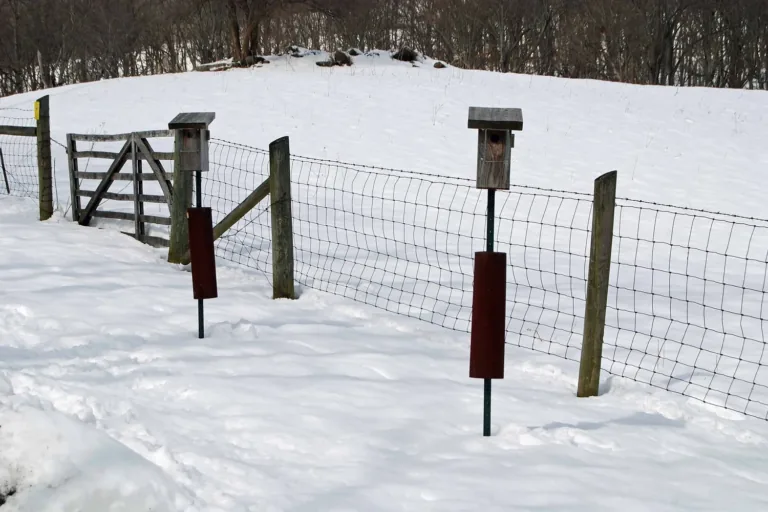
Mount on a metal pole with a predator baffle — a cone or stovepipe-style guard positioned below the box. Raccoons, snakes, cats, and squirrels are all capable of raiding a box mounted on a wooden post or directly on a fence. A properly installed baffle is the most important predator protection measure available. A box without one will eventually be raided.
Space boxes at least 100 meters apart if installing multiple boxes. Bluebirds defend their territory actively against other bluebirds, and boxes too close together cause conflict that typically results in neither pair settling.
Pair boxes 5 to 15 meters apart to accommodate tree swallows. Tree swallows compete with bluebirds for boxes but not territorially in the same way — they’ll tolerate a bluebird pair nearby. Pairing boxes allows both species to nest, which reduces competition and actually increases the total number of nesting pairs you support.
The house sparrow problem
House sparrows are the primary ongoing threat to bluebird nesting success, and this is where most guides lose people because the honest advice is difficult to hear.
House sparrows are non-native, invasive, and not protected by the Migratory Bird Treaty Act. They aggressively claim boxes, destroy bluebird eggs and young, and sometimes kill adult bluebirds inside boxes. If house sparrows are common in your area — which they are in most suburban and urban neighborhoods — an unmonitored box will become a house sparrow box.
The consensus among bluebird conservationists is unambiguous: the only effective response is active management, meaning removing house sparrow nests and eggs from boxes immediately when found. This requires checking boxes at least weekly during nesting season.
If you’re unwilling or unable to monitor boxes regularly, putting up a bluebird box in house sparrow territory does more harm than good — it simply provides a protected nesting site for an invasive species that will outcompete the native birds you’re trying to help.
Monitoring: the part people skip
A nest box isn’t something you install and walk away from. Monitoring is what makes the difference between a functioning bluebird habitat and a house sparrow hotel.
Check the box weekly during nesting season (roughly March through August across most of the range). Open it, look in, and note what you find. Opening the box does not disturb nesting birds — bluebirds are comfortable with regular human presence near the box and typically flush briefly and return.
What to look for: bluebird nests are a compact cup of fine dried grass, sometimes with pine needles. House sparrow nests are bulky, loose piles of grass, feathers, string, and debris that fill the box. Remove house sparrow nests immediately. Tree swallow nests are grass cups lined with white feathers — leave those alone, as tree swallows are native and beneficial.
Clean the box out completely after each nesting attempt concludes and fledglings have left — this prevents mites and parasites from accumulating and makes the box more attractive for a second or third brood.
Providing food: mealworms
Bluebirds are not seed eaters and won’t visit a typical seed feeder. The food offering that attracts them is live or dried mealworms.
A shallow dish placed on a post or fence near the nest box, reliably stocked with mealworms, can establish a bluebird pair’s trust quickly — especially early in the season before insects are abundant, during cold snaps, or when feeding nestlings. The North American Bluebird Society’s mealworm factsheet has guidance on quantities and timing to avoid creating dependency.
Freeze-dried mealworms work in winter when live ones aren’t practical. During nesting season, live mealworms in a smooth-sided dish that escapees can’t climb out of are preferable.
Water
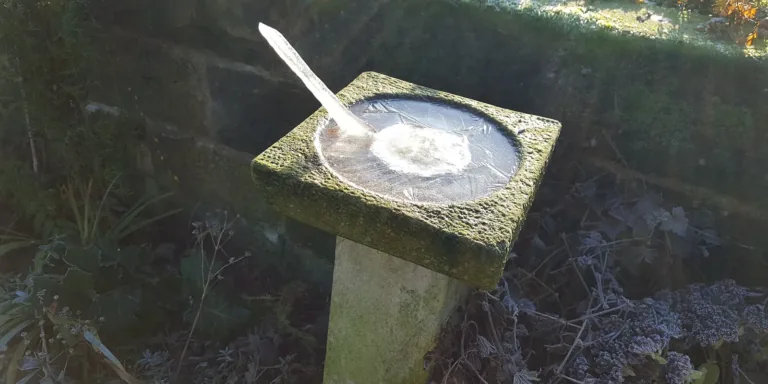
Bluebirds bathe and drink readily if water is available with suitable perches nearby. A shallow birdbath — no more than 2 inches deep, with a rough surface or flat rocks for footing — placed in the open near the nest box is used reliably. Keep it clean and refreshed; standing water that goes stagnant isn’t attractive.
The bee waterer design principles — shallow, safe, stable footing — apply here too.
Winter: leave the box up
Bluebirds don’t always migrate. Across much of their range, eastern bluebirds overwinter, often roosting communally in nest boxes on cold nights — sometimes a half-dozen birds packed together for warmth. Leaving boxes up year-round gives overwintering birds roosting habitat that can be the difference between surviving a cold snap and not.
Clean and inspect boxes in late winter before nesting season begins, and they’ll be ready for the first scouts arriving in February or March.
Frequently asked questions
Why won’t bluebirds use my nest box? Almost always habitat. If the box is in a wooded yard, surrounded by shrubs, in shade, or without a large open foraging area nearby, bluebirds have no reason to settle there. The box itself is rarely the issue.
Do bluebirds come back to the same box every year? Yes, frequently. Pairs that successfully raise young in a box will typically return to it the following season. This is one reason monitoring and maintaining boxes in good condition pays off over time.
What’s the best location for a bluebird box? On a metal pole with a predator baffle, 4 to 6 feet high, facing open ground, 15 to 30 meters from the nearest tree line or woodland edge, in full or partial sun.
Should I put nesting material inside the box? No. Bluebirds collect and arrange their own nesting material. Adding material can actually make the box less attractive.
Can bluebirds and tree swallows share the same area? Yes, and the standard approach is to pair boxes roughly 5 to 15 meters apart. Bluebirds won’t tolerate another bluebird pair within 100 meters, but they’ll accept tree swallows as near neighbors.
When do bluebirds start nesting? Eastern bluebirds are among the earliest nesters — scouting for cavities as early as February in warmer parts of their range, with nesting beginning in March or April across most of the eastern US. Have boxes clean and ready by late February.