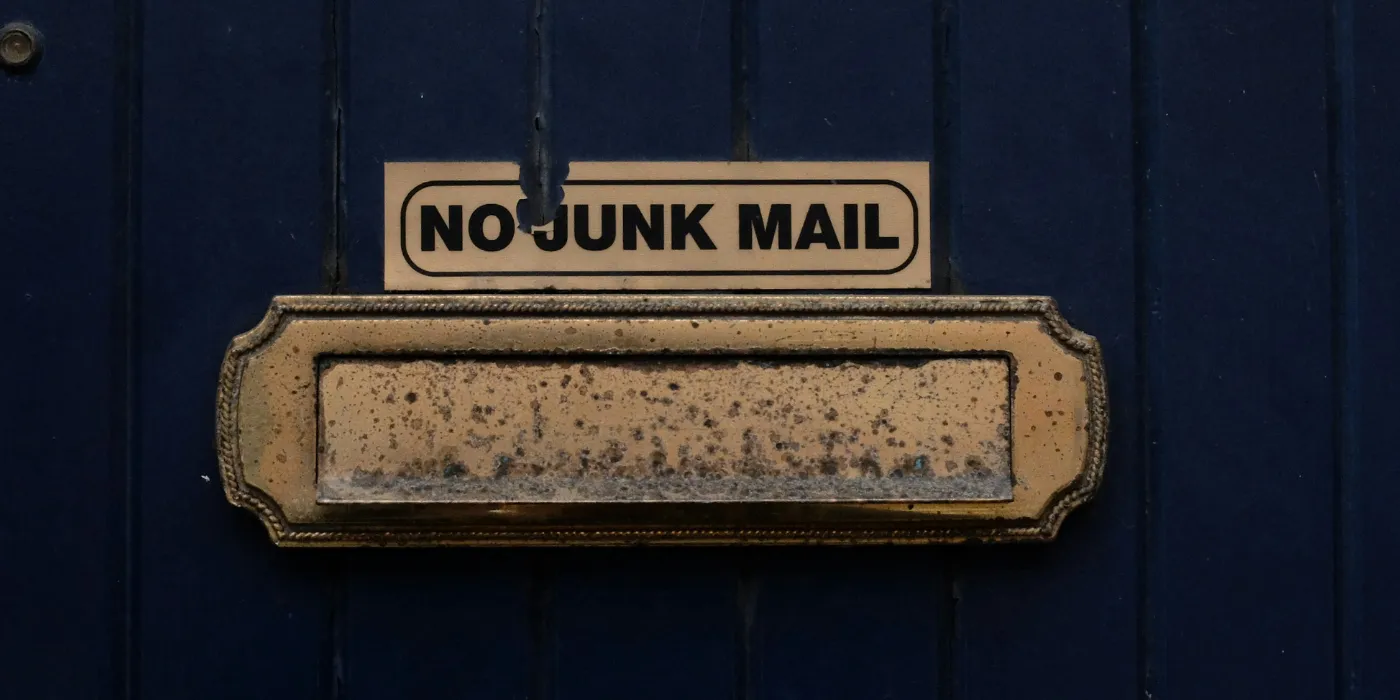
How to Stop Junk Mail: The Complete Guide to Opting Out for Good
- Give A Shit About Nature
- April 12, 2026
- Sustainable Living
- 0 Comments
Most people quietly accept junk mail as one of life’s minor irritants — sort, recycle, repeat. But the scale of the problem is hard to ignore once you see it clearly.
An estimated 100 million trees are cut down in the U.S. every year to produce junk mail — the equivalent of clearing all the trees in Rocky Mountain National Park every four months. The production process consumes roughly 28 billion gallons of water annually. The EPA reports that 60% of all junk mail ends up in landfills, not recycling bins. The carbon footprint is equivalent to the emissions of nine million cars.
The good news: you can dramatically reduce — and in many cases nearly eliminate — the junk mail coming to your address. It takes about an hour of setup and some occasional maintenance. Here’s exactly how.
Step 1: Opt out of pre-screened credit and insurance offers
This is the single largest category of junk mail for most households — those pre-approved credit card and insurance offers that seem to multiply on their own. They’re generated by the major credit bureaus, which sell your contact information to lenders and insurers.
The official opt-out mechanism is OptOutPrescreen.com, operated jointly by Equifax, Experian, TransUnion, and Innovis — it’s legitimate and safe. You can opt out for five years online, or opt out permanently. The permanent option requires completing the online request first, then signing and returning a Permanent Opt-Out Election form by mail. You’ll be asked for your name, address, and optionally your Social Security number and date of birth — the latter two are optional but help ensure the request goes through correctly. You can also do everything by phone at 1-888-567-8688.
Allow up to 60 days for results. Mail already in production will still arrive in the meantime.
Step 2: Register with DMAchoice
The Association of National Advertisers runs DMAchoice, a mail preference service that lets you manage what categories of marketing mail you receive — catalogs, magazine offers, credit offers, and general promotional mail. Registration costs $6 online and lasts 10 years.
Important caveats: DMAchoice only covers companies that are ANA members, and it won’t stop mail from companies you already have an existing customer relationship with — those require direct contact. Expect up to 90 days before you see a meaningful reduction, since mail already in the pipeline will keep coming.
It’s an imperfect tool, but it’s one of the highest-leverage single actions you can take.
Step 3: Stop catalogs with Catalog Choice
Catalog Choice is a free nonprofit service that contacts merchants directly on your behalf to process opt-out requests. Their database covers nearly 10,000 senders — clothing brands, retailers, charities, credit card companies, and more. It’s run by The Story of Stuff Project and has helped over two million people reduce their mail.
To use it: sign up, search for the sender, and submit the opt-out. Allow up to eight weeks for each request to take effect. One particularly useful feature: Catalog Choice can also process opt-outs on behalf of a deceased family member or a previous occupant at your address — one of the most persistent sources of junk mail that’s otherwise hard to stop.
Step 4: Opt out of the Abacus/Epsilon data cooperative
This step is unknown to most people and worth doing. Abacus, owned by Epsilon, is a data cooperative through which catalog companies share customer purchase information with each other. If you’ve ever ordered from one catalog, dozens of others may have received your information as a result. Opting out stops that data sharing at the source.
Email abacusoptout@epsilon.com with your full name and mailing address requesting removal. It’s free and takes about two minutes.
Step 5: Opt out of Valpak
Valpak sends those familiar blue envelopes stuffed with local coupons to recipients who never signed up for them. If you don’t use them, opt out directly on the Valpak website. Enter your address and you’ll be removed from their mailing list. This one tends to stick — many people report their opt-out being honored for years.
Step 6: Stop unwanted phone books
If you’re among the majority of people who put the phone book directly in the recycling bin, Yellow Pages allows you to opt out of local directory deliveries at their opt-out portal. It covers many but not all local directories, so if you continue receiving books from a different publisher, contact them directly.
Step 7: Use Acxiom’s opt-out tool
Acxiom is one of the largest data brokers in the world and a major behind-the-scenes source of mailing lists. You can request removal from Acxiom’s marketing database for free. Make sure you click the confirmation link they send to your email — without that step, the request doesn’t process.
Step 8: Handle the rest piece by piece
Some junk mail falls through every net above — local businesses, political mailers, charities, and senders not affiliated with any of the services listed. For these, the approach is straightforward: every piece of junk mail has some form of contact information on it. Use it. Call, email, or write to request removal, and ask specifically that your information not be shared with other companies. Keep the mailing label when you do — the codes printed near your address help companies locate your record faster.
One useful trick from postal regulations: if a piece of mail carries the endorsement “Return Service Requested,” “Address Service Requested,” or similar language, you can write “REFUSED — RETURN TO SENDER” on the unopened envelope and place it back in your mailbox. Your mail carrier will return it at the sender’s expense.
What about Every Door Direct Mail?
There’s one category of junk mail that none of the above will stop: Every Door Direct Mail (EDDM), a USPS service that allows businesses to blanket an entire ZIP code with mailers addressed simply to “Resident” or “Our Neighbors At.” Real estate agents, local contractors, pizza places, and new businesses use it heavily. There is no mailing list to opt out of — if you have a mailbox in the target ZIP code, you’re getting it.
This is the last frontier of junk mail for people who have completed all the other steps, and unfortunately there’s no clean solution. The most practical approach is to contact senders you see repeatedly and ask to be removed from their specific campaigns, though EDDM mailers aren’t legally required to honor individual removal requests the way list-based mail is.
Does this actually work?
Yes, meaningfully — but it’s not a one-time fix. The experience reported by people who go through all these steps is a sharp drop in mail volume within two to three months, followed by a slow trickle resuming over the following year or two as new data sources pick up your address. Treating it as annual maintenance — a quick pass through the steps above once a year — keeps the volume low.
The opt-outs with the longest staying power tend to be OptOutPrescreen (especially the permanent option), Valpak, and Catalog Choice. DMAchoice requires re-registration every 10 years.
What about the post office?
A reasonable concern: doesn’t all this junk mail support postal workers and keep local post offices funded? It does, to a degree. But first-class mail generates more revenue per piece for the USPS than bulk marketing mail. The bigger threat to the post office is that people send fewer personal letters, not that individuals opt out of marketing lists. If you want to support the postal service, send someone a letter.
A note on privacy
One underappreciated reason to do all of this beyond the environmental argument: junk mail is a meaningful identity theft vector. Pre-approved credit offers arriving at your address can be stolen from your mailbox and used to open accounts in your name. Reducing the volume of financially sensitive mail you receive is a legitimate personal security measure, not just a decluttering exercise.
The full checklist
- OptOutPrescreen.com — credit and insurance pre-screened offers (free, permanent option available)
- DMAchoice — broad marketing mail suppression ($6, 10 years)
- Catalog Choice — catalogs and specific senders (free)
- Acxiom opt-out — data broker removal (free)
- Email abacusoptout@epsilon.com — Abacus/Epsilon data cooperative (free)
- Valpak opt-out — blue coupon envelopes (free)
- Yellow Pages opt-out — phone book delivery (free)
- Individual senders — for anything that gets through (free, ongoing)
Total cost to do everything: $6. Total time: about an hour upfront, plus occasional maintenance.
Frequently asked questions
How long does it take for junk mail to stop after opting out? Most services take 60 to 90 days to take effect, since mail already in production will keep arriving. DMAchoice specifically recommends allowing 90 days. OptOutPrescreen tends to work faster, often within 30 to 60 days.
Will junk mail ever start again after opting out? Yes, gradually. Marketers continuously acquire new data, and your address can re-enter circulation through new purchases, warranty registrations, or data broker updates. Doing a quick maintenance pass through the key services once a year keeps volume low. The original opt-outs don’t expire quickly — DMAchoice lasts 10 years, and OptOutPrescreen’s permanent option is indefinite.
What’s the best way to stop charity solicitation mail? Charity mail is a specific category that falls outside most opt-out services because you often have an existing relationship with the organization. The most effective approach is to call or email the charity directly and ask to be removed from their mailing list — most reputable organizations will honor this promptly. You can also use Catalog Choice, which covers some nonprofit senders.
Is it safe to use OptOutPrescreen? It asks for personal information. Yes. OptOutPrescreen.com is operated by the four major credit bureaus and is the official, FTC-recognized opt-out mechanism for pre-screened offers. The FTC’s own consumer guidance directs people to this site. Your Social Security number and date of birth are optional fields — providing them helps match your record but is not required to complete the opt-out.
Can I stop mail addressed to a previous resident? Yes. Catalog Choice specifically supports opt-outs on behalf of previous occupants. For other services, you can generally submit the opt-out using the previous resident’s name at your current address. For individual senders, writing “Not at this address — return to sender” on the envelope and placing it back in your mailbox is an effective method that prompts the sender to update their records.
Does recycling junk mail solve the problem? Recycling is better than landfill, but it doesn’t address the production side — the trees, water, and carbon emissions involved in creating the mail in the first place. Opting out prevents the waste from being generated rather than just managing it after the fact.