Finding a baby bird on the ground is one of those moments where every instinct you have tells you to do something. Pick it up. Help it. Save it. Those instincts come from a good place — but acting on them too quickly is actually one of the most common ways people accidentally harm the very bird they’re trying to help.
Here’s the good news: most baby birds you’ll find on the ground don’t need your help at all. And the ones that do need help? There’s a clear path for that too.
The first thing to do: figure out what kind of baby bird you’re looking at
Not all baby birds on the ground are in the same situation. Before you do anything, take a breath and look closely. The answer to almost everything depends on one key distinction.
Is it a nestling or a fledgling?
These are two very different situations requiring two very different responses.
Nestlings: these birds need help
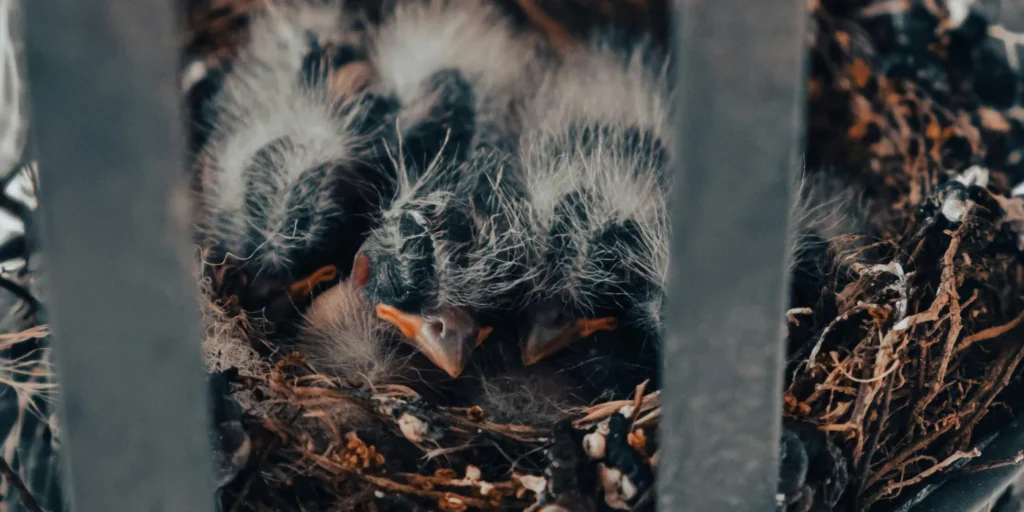
A nestling is a young bird that is not ready to be out of the nest. You’ll recognize one because it either has no feathers at all, or only sparse, patchy down — maybe some pin feathers just starting to push through. Its eyes may be closed or barely open. It probably can’t stand up properly or grip anything with its feet. It looks, honestly, a little alien.
If you find a nestling on the ground, it did not get there on purpose. It either fell, was pushed out by a sibling, or the nest was disturbed. This bird needs to go back into a nest.
What to do:
Look up. The nest is almost certainly nearby — within a few yards, in a tree or shrub above where you found the bird. It may be well hidden, so look carefully.
If you can find it and safely reach it, pick the nestling up gently and place it back in the nest. Don’t hesitate because you think your scent will cause the parents to abandon it. That’s one of the most persistent myths in backyard wildlife, and it’s not true. According to the Cornell Lab of Ornithology, parent birds do not recognize their young by smell, and they will not abandon a baby because it has been touched by human hands. Miyoko Chu, a biologist at Cornell, puts it plainly: “Birds don’t have a very strong sense of smell, so you won’t leave a scent that will alarm the parent.”
Pick the bird up. Put it back. Then step away and watch from a distance to make sure the parents return.
If you can’t find the nest or it’s been destroyed:
You can make a substitute nest. A small plastic container like a margarine tub works — punch a few drainage holes in the bottom so water doesn’t pool, line it with dry grass or the material from the original nest if you can gather it, and tie or wedge it securely in the tree as close to the original location as possible. Place the nestling inside and watch from a distance for the parents to return. According to Mass Audubon, parent birds will typically return to a well-placed substitute nest.
Fledglings: these birds are doing exactly what they’re supposed to do
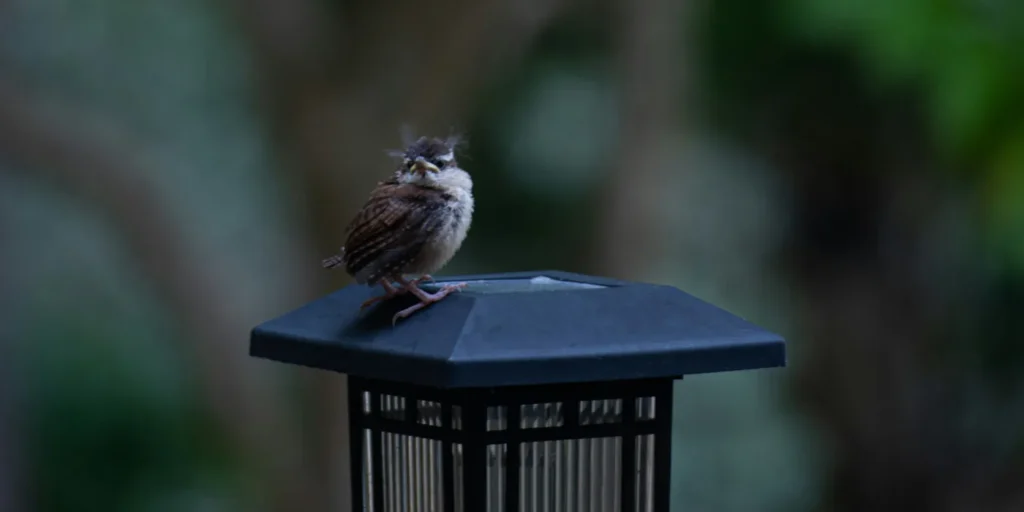
This is the most important thing in this entire article, and it’s where most well-meaning people go wrong.
A fledgling is a bird that has left the nest intentionally. It’s covered in real feathers — it might look a little scraggly with a stubby tail and some fluffy patches still showing, but it’s feathered. It can hop. It can grip a branch with its feet. It probably looks at you with bright, alert eyes. It might even try to hop away from you.
Fledglings leave the nest before they can fly. That is completely normal. It is an intentional stage of development. According to Audubon, as many as 80% of baby birds brought to wildlife rehabilitation centers are healthy fledglings that were “rescued” by people who didn’t know better. “Eighty percent of baby birds that come in have basically just been kidnapped,” says Melanie Furr, education director at Atlanta Audubon Society.
The fledgling’s parents know exactly where it is. They’re watching it. They’re coming back to feed it. The fledgling will spend several days on the ground or in low vegetation, getting stronger and learning to fly, under the watchful care of parents that will loudly dive-bomb anything that comes near. This is how birds grow up.
What to do with a healthy fledgling:
Leave it alone. Step back, go inside, keep your pets in. Watch from a window if you’re worried. Within an hour or two, you should see a parent come to feed it. If the parents are returning, everything is fine.
If the fledgling is in immediate danger — a busy road, a cat lurking nearby — you can gently move it to a nearby shrub or low branch. Keep it close to where you found it. The parents will find it. Do not bring it inside.
Signs a bird — fledgling or nestling — actually needs help
Whether you’re looking at a nestling that can’t be returned to a nest, or a fledgling that’s behaving in a way that concerns you, these are the signs that something is genuinely wrong:
- Visible injuries — bleeding, a drooping wing, a leg that won’t bear weight
- Wet feathers when it isn’t raining (can indicate illness that affects oil production)
- Surrounded by flies or maggots
- Shivering and unable to maintain an upright position
- Lying completely still and unresponsive
- You know for certain the parents are dead
If you observe any of these, the bird needs professional care.
What to do if a bird actually needs help
Step 1: Contain it safely. Line a cardboard box with paper towels. Place the bird inside. Put a small hot water bottle wrapped in a cloth, or a heating pad on its lowest setting under half the box, to help keep the bird warm — but make sure the bird can move away from the heat source if needed. Put a piece of cloth loosely over the top of the box (with air holes) to keep the bird calm and dark.
Step 2: Do not feed it or give it water. This is critical. Baby birds have very specific nutritional needs and feeding them the wrong thing — bread, water, worms — can kill them. Even well-intentioned feeding can cause aspiration or serious harm. Leave the feeding to professionals.
Step 3: Contact a licensed wildlife rehabilitator immediately. The National Wildlife Rehabilitators Association directory lets you search by location. Your local animal control office can also refer you to a rehabilitator in your area. Most wildlife rehabilitators operate as nonprofits and provide care at no charge.
Step 4: Transport carefully. Keep the box warm, dark, and quiet. Don’t let children or pets handle the bird. Minimize talking and movement around it. The calmer the bird stays, the better its chances.
Find a wildlife rehabilitator
Tap your state, or pick it from the menu.

You’ll get the official state list or guidance page, plus Animal Help Now.
Snapshot taken October 10, 2026. The main button goes to each state wildlife agency. Animal Help Now is an independent nonprofit. If it’s an emergency with a human injury, call 911. Rehabilitators are volunteers and may not answer right away.
A note on taking birds home
It’s worth knowing: it is illegal in the United States to keep a wild bird, even temporarily, without a wildlife rehabilitation permit. This isn’t just a technicality — it exists because birds raised by well-meaning humans often can’t be released successfully. They miss critical developmental windows for learning to find food, recognize predators, and behave like the bird they are. The best outcome for any baby bird is a wildlife rehabilitator, not a shoebox in your spare bedroom.
What to do if you’re not sure what you’re looking at
If you genuinely can’t tell whether what you’ve found is a nestling or fledgling, or whether it needs help, the safest move is to take a photo and reach out before touching the bird. You can contact:
- Your local wildlife rehabilitator
- Your state’s wildlife agency or Department of Natural Resources
- The Cornell Lab of Ornithology’s eBird helpdesk for species identification
- A local Audubon Society chapter
Most of these organizations are used to getting exactly this kind of question in spring and summer, and they’ll tell you quickly what you’re looking at and what — if anything — to do.
Frequently asked questions
Will touching a baby bird cause its parents to abandon it? No. This is one of the most persistent myths in backyard wildlife, and it is false. According to the Cornell Lab of Ornithology and confirmed by multiple ornithologists, birds have a limited sense of smell and do not recognize their young by scent. Handling a nestling and returning it to its nest will not cause the parents to reject it. The bigger risk is disturbing the area around the nest repeatedly, which can attract predators.
How long should I wait to see if the parents come back? For a nestling you’ve returned to its nest, watch from a distance for one to two hours. For a fledgling on the ground, watch from inside if possible — the parents may be avoiding the area because of your presence. If no parent has appeared after a couple of hours and the bird seems cold, weak, or distressed, contact a rehabilitator.
What if I can’t find a wildlife rehabilitator? Call your local animal control office or veterinarian — most can refer you to one or provide temporary guidance. You can also search wildlifehotline.com or call the Humane Society wildlife helpline for direction.
What if my cat caught the bird? Even if the bird appears uninjured, a cat’s mouth carries bacteria that can cause fatal infections in birds within 24 to 48 hours. A bird that has been in a cat’s mouth needs veterinary or rehabilitator care immediately — this is not a wait-and-see situation.
Can I give the bird water or food while I wait? No. Even if the bird seems dehydrated or hungry, do not attempt to feed or water it. The risk of harm from incorrect feeding is high. Keep the bird warm, dark, and calm until you can reach a rehabilitator.
Is it illegal to keep a wild bird? Yes. In the United States, virtually all wild birds are protected under the Migratory Bird Treaty Act, which makes it illegal to possess them without a federal permit. This applies even to brief “temporary” care. If you find a bird that needs help, the legal and most effective path is a licensed wildlife rehabilitator.