Cardinal Flower: The Native Hummingbird Plant Every Eastern Garden Needs
- Give A Shit About Nature
- May 14, 2026
- Native Plants
- 0 Comments
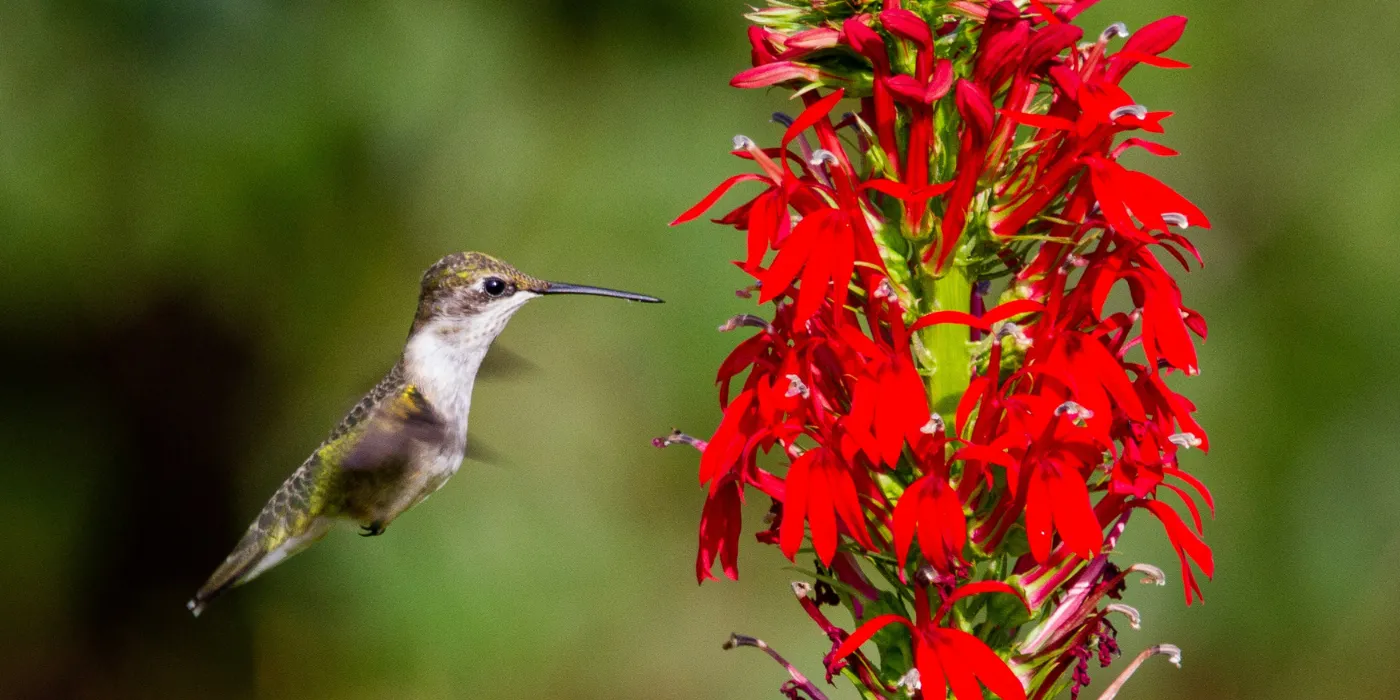
Most people who plant cardinal flower think of it as a hummingbird attractor. That framing is accurate, but incomplete. The ruby-throated hummingbird doesn’t visit cardinal flower because it’s a pretty red flower that happens to be nearby.
It visits because these two species have co-evolved over millions of years into something that functions almost like a contract: the flower provides high-calorie nectar in a tube calibrated precisely for a hummingbird bill, and the hummingbird cross-pollinates at a scale and consistency no insect can match.
What makes cardinal flower significant beyond that relationship is its timing. It blooms from late summer into early fall, precisely when ruby-throated hummingbirds are fueling up for migration south across the Gulf of Mexico, a crossing that burns extraordinary energy reserves in a bird that weighs about as much as a quarter. Audubon North Carolina specifically identifies this window: mid-August through October is when cardinal flower provides critical nectar for southbound migrants moving through.
That timing isn’t incidental. It’s the entire argument for planting this species.
The Window That Most Gardens Miss
A yard planted entirely with spring and early summer bloomers supports pollinators well for part of the season and then drops off. Hummingbirds arrive in the East in late April and May when columbine blooms, which is wonderful, but the real energy demand comes in August and September when migration is underway and birds are trying to accumulate fat reserves as quickly as possible.
Late summer is actually one of the hardest gaps to fill in a native planting. Bee balm has finished. Most coneflowers have peaked. Native goldenrods and asters are starting but offer little to hummingbirds, which need high-calorie nectar from tubular flowers rather than the open-faced composites that bees prefer. Cardinal flower fills that window more completely than almost anything else in the eastern native plant palette.
Cardinal flower produces flower spikes that bloom progressively from bottom to top, meaning a single stalk can be in bloom for several weeks. A patch of them staggers those weeks even further. The plant is not done when August is. That extended late-season bloom is the ecological contribution most gardeners don’t fully account for when they’re planning spring purchases.
Why Hummingbirds and Cardinal Flower Belong Together
The flower’s architecture tells the whole story. The corolla tube is long and narrow, positioned perfectly for a hummingbird that hovers in front and inserts its bill to reach the nectar at the base. As it does, the anthers deposit pollen on the top of the bird’s head — and that pollen transfers to the stigma of the next flower the bird visits.
Most bees can’t reach the nectar through the normal route at all. Some bees rob the nectar by biting into the base of the bloom, bypassing the flower’s pollination mechanism entirely.
They get the food without delivering the service. Hummingbirds are the efficient pollinators this flower actually depends on, and the Lady Bird Johnson Wildflower Center’s database confirms that most insects find the long tubular flowers difficult to navigate, meaning hummingbirds face minimal competition at cardinal flower blooms — which makes those blooms even more attractive to visiting birds who learn them as reliable, low-competition feeding stations.
This co-evolutionary relationship is what we mean when we talk about native plants being more ecologically connected than ornamentals. A non-native salvia might attract hummingbirds. Cardinal flower has a relationship with them that developed over evolutionary time and is built into the flower’s structure, bloom chemistry, and timing.
Where This Plant Actually Belongs
Cardinal flower’s natural habitat is stream banks, woodland edges, and moist lowlands throughout the eastern half of North America, extending west through the Great Plains and into parts of the Southwest. That origin informs what it needs in a garden: moisture. Not swamp conditions, but consistent moisture and reasonable organic content in the soil.
The most common failure with cardinal flower is planting it in conditions that are too dry. A sunny perennial border with well-drained soil is where most summer-blooming perennials thrive — and where cardinal flower may struggle, particularly through a dry August. The soil drying out is the primary reason plants fail in their first season.
The fix isn’t complicated but it does require matching the plant to the right spot. Moist garden beds, rain garden edges, spots near a downspout where water lingers, or low areas that stay damper than the rest of the yard — these are where cardinal flower performs without complaint. It can handle partial shade, which matters because moist areas in most yards tend to be under tree canopy or on north-facing slopes.
This is one of the few native plants that delivers significant wildlife value in part shade with wet feet, a combination that limits most of the best-performing sun-loving natives.
NC Cooperative Extension specifically recommends it for rain gardens, and that application works beautifully in practice. A rain garden that features cardinal flower gives you ecological function in the drainage layer of your yard and a migration fuel stop at exactly the right time of year.
Short-Lived, But Self-Perpetuating When You Let It
Cardinal flower is technically perennial but often behaves more like a biennial or short-lived perennial in garden conditions. Individual plants may persist for two to three years, sometimes longer, and then decline. This surprises gardeners who planted it expecting a decades-long presence.
The key is understanding how it perpetuates. At the base of a blooming stalk, basal rosettes form during the growing season and overwinter as low leafy rosettes. Those rosettes are the next generation of plants. Try not to remove the entire plant after it blooms. Those basal rosettes need to stay, because they’re what blooms next year.
Cardinal flower also self-seeds readily when the conditions are right, and in moist soils near water it can naturalize over time into a self-sustaining colony that requires no intervention. This is the behavior you see in wild populations along stream banks, where it doesn’t need gardeners to persist.
For garden purposes, leaving seed heads to ripen and fall naturally supplements the basal rosette propagation. Some gardeners deliberately scatter seed in adjacent spots to expand the planting gradually. The plant rewards this low-intervention approach more than it rewards tidying and deadheading.
Cultivars like ‘Black Truffle’ (dark foliage, red flowers) and ‘Alba’ (white flowers) are widely available, and while they’re visually interesting, hybrids with related species may produce less nectar than the straight species. If the goal is migration support, the straight species Lobelia cardinalis is the conservative choice.
The System Around It
Cardinal flower doesn’t work in isolation. The case for planting it strengthens considerably when it’s part of a broader native planting that provides something for hummingbirds from spring arrival through fall departure. Wild columbine covers the early migration window in April and May. Bee balm and native salvias handle June and July. Cardinal flower picks up in August and carries through September, overlapping with the goldenrods and asters that sustain other pollinators through fall.
This kind of sequential bloom planning is the difference between a yard that attracts hummingbirds briefly and one that serves as reliable habitat they return to consistently. Once a hummingbird learns your yard as a dependable feeding source, it incorporates it into a regular route — and that behavioral learning is exactly what makes a yard part of the migration corridor rather than a one-time stop.
The moisture requirements that guide where you place cardinal flower also connect it to a broader riparian guild of native plants worth knowing. Blue lobelia (Lobelia siphilitica) is a close relative that blooms in late summer with blue flowers, provides nectar for bumblebees specifically, and thrives in identical wet conditions. The two together, planted in adjacent moist spots, extend habitat value in both the hummingbird and native bee directions simultaneously.
Leaving the standing stems of cardinal flower through winter contributes to the overwintering habitat value of the planting, since the hollow pithy stems can shelter native cavity-nesting bees. The plant you’re growing for August hummingbirds is doing secondary work in February for native bees. That’s a pattern across native plantings worth recognizing.
Growing Cardinal Flowers
- Native range: Eastern and central North America, extending into parts of the Southwest and Central America.
- USDA hardiness zones: 3–9, with some variation by ecotype.
- Height: Typically 2–4 feet; occasionally to 6 feet in optimal conditions.
- Bloom time: Late June through September, peaking in August and September across much of the range.
- Light: Full sun to partial shade. Tolerates more shade than most hummingbird plants.
- Soil: Moist to wet, organically rich. Does not tolerate drought well once established.
- Water: Consistent moisture required; excellent for rain gardens, streamside planting, and low spots.
- Propagation: Seed (surface sow, needs light to germinate), division of basal rosettes in spring, or stem cuttings.
- Notable cultivars: ‘Black Truffle’ (dark foliage), ‘Alba’ (white), ‘Fried Green Tomatoes’ (green foliage accent); straight species preferred for maximum nectar production.
FAQ
Will cardinal flower grow in my garden if I don’t have wet soil? It can, but consistent moisture matters. In drier sites, incorporating organic matter and supplemental watering during dry periods in the first year significantly improves establishment. A mulched bed that retains moisture longer is better than bare, fast-draining soil.
Is cardinal flower the same as cardinal climber or cardinal creeper? No. Cardinal flower is Lobelia cardinalis, a native perennial wildflower. Cardinal climber is a tropical annual vine (Ipomoea x multifida). They share a name and a color; that’s the extent of the relationship.
My cardinal flower died after the first year. What happened? Two likely causes: the site was too dry, or the basal rosettes that overwinter at the plant’s base were removed during fall cleanup. Leave basal rosettes in place after bloom and ensure consistent moisture through the growing season.
Can cardinal flower grow in a container? Yes, with consistent watering. Containers dry out faster than garden beds, so this approach requires attention during summer. A large container with moisture-retentive mix works better than a small pot in a sunny location.
Is cardinal flower deer-resistant? It has some deer resistance, which may be related to mild alkaloids in the plant, but deer pressure and plant palatability vary enough by region that this shouldn’t be relied on as a certainty.