Before anything else: which sparrow are you dealing with?
If the answer is house sparrows, the chunky, aggressive, brown-streaked birds that showed up from England in the 1850s and have been taking over nest boxes ever since, you have real options and clear legal authority to use them.
If the answer is native sparrows like song sparrows, white-throated sparrows, or chipping sparrows, those are protected under the Migratory Bird Treaty Act and cannot be legally harassed, trapped, or removed.
This distinction matters enormously, because the management approaches that are entirely legal for house sparrows would be federal violations if applied to native birds. The rest of this article is about house sparrows specifically.
Why Are House Sparrows A Problem?
House sparrows (Passer domesticus) are not native to North America. They were introduced from England beginning in the 1850s under the mistaken belief that they’d help control agricultural pests. The North American Bluebird Society’s control factsheet notes that they spread across the entire continent within 50 years from a starting population of around 100 birds, an extraordinary colonization.
Because they’re non-native, house sparrows are specifically excluded from Migratory Bird Treaty Act protection, and the U.S. Fish and Wildlife Service has for decades explicitly endorsed removing their nests, eggs, and adults from artificial nest boxes erected to benefit native cavity nesters like bluebirds and tree swallows.
The problem is real. House sparrows compete aggressively for nest cavities, and Cornell Lab’s NestWatch program data documents them killing the adult occupants of nest boxes they want to take over. This isn’t occasional. Many experienced bluebird landlords have found dead adult bluebirds in their boxes killed by house sparrows defending the cavity.
Getting Them Away From Feeders
House sparrows favor millet, cracked corn, and bread. Switching feeder contents is one of the simplest and most effective first steps. Sialis.org’s management guide recommends shifting to black oil sunflower seeds, safflower, thistle (nyjer), and suet, foods that native birds use readily but house sparrows prefer significantly less.
Feeder design also matters. Tube feeders with short perches are harder for house sparrows to use comfortably than open platform or hopper feeders. Reducing spillage beneath feeders removes the ground-level foraging that house sparrows particularly enjoy.
The “Magic Halo” deserves mention because it sounds strange and actually works. It’s a series of weighted monofilament lines hung around a feeder at roughly bird-head height. The visual obstruction bothers house sparrows more than native birds, and Feathered Guru’s management guide describes it as one of the more reliably effective passive deterrents for feeders specifically.
None of these will eliminate house sparrows from your yard, but they’ll reduce feeder dominance enough for native birds to use the food you’re putting out.
Protecting Nest Boxes
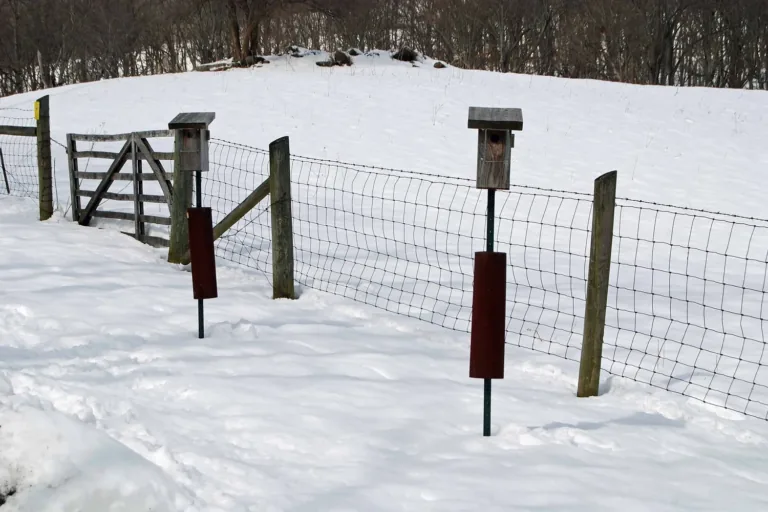
This is where the situation is most serious and where active management is most justified. A nest box that house sparrows take over isn’t just losing housing for a bluebird — the bluebird that was already nesting may be killed.
The legal framework is clear. NestWatch states directly: removing house sparrow nesting materials from a box repeatedly, every few days, discourages them from completing a nest and eventually pushes them elsewhere. This works best as a single-box strategy because displaced sparrows may simply move to the next box on a trail and cause the same problem there. For a trail of multiple boxes, more active intervention may be necessary.
House sparrow nests are identifiable: messy, loosely built, with coarse grass and debris versus the tidy woven grass cup of a bluebird nest. Once you can tell the difference, nest checks take about 30 seconds.
A Sparrow Spooker is a useful passive tool for occupied bluebird boxes specifically. Installed after the first bluebird egg appears, it consists of reflective Mylar strips suspended above the entrance hole. Biology Insights describes the strips deterring sparrow approaches while bluebirds habituate to them quickly. It must come down after the bluebirds fledge, or it becomes a deterrent to the next occupants as well.
Entrance hole restrictors sized to 1-1/8 inches exclude house sparrows while admitting smaller native cavity nesters. For bluebird boxes specifically, PVC Gilbertson-style boxes appear to be less attractive to house sparrows than wood boxes, though this is a preference rather than a guarantee.
Trapping: What It Involves and What the Law Requires
Trapping is an option where passive deterrence isn’t keeping up with the problem. NestWatch’s guidance on trapping says that traps must be checked at least hourly to prevent non-target species from suffering unnecessary stress, and trap operators need sufficient identification skills to confidently distinguish house sparrows from native sparrows before removing any bird from a trap. This is a real requirement, not a suggestion.
Box traps placed inside nest boxes are one common approach. They must be removed when not actively monitored. The USFWS endorsement covers humane euthanasia of trapped house sparrows; relocation is ineffective because house sparrows rapidly reclaim territory or find equivalent habitat elsewhere.
Some state laws impose additional restrictions on trapping methods even for unprotected species, so checking with your state wildlife agency before setting any trap is worth the phone call.
If You Haven’t Put Up a Nest Box Yet
The best piece of advice, if you’re starting from scratch, comes from Sialis.org’s Thomas Valega: “It is better to have no nestbox at all than to allow House Sparrows to breed in one.” A nest box you put up and don’t monitor creates habitat for house sparrows at the expense of native birds. If you’re not willing or able to check a box weekly during nesting season, it’s worth waiting until you can.
We’ve written about attracting bluebirds and why most nest boxes go empty — a lot of that comes down to placement and the house sparrow problem. The short version is that monitoring is not optional. A box in sparrow territory without active management is a trap for native birds, not a benefit.
If you do monitor consistently and manage house sparrows as they appear, nest boxes are genuinely one of the highest-impact things a backyard birder can do for cavity-nesting native species. Keeping bird feeders clean and reducing window collisions are the other high-impact actions worth combining with nest box management for a yard that genuinely supports native birds.
Read More: How to Attract Bluebirds (And Why Most Nest Boxes Go Empty)
FAQ
Are house sparrows protected by law? No. House sparrows are non-native and specifically excluded from Migratory Bird Treaty Act protection. Their nests, eggs, young, and adults may be legally removed by individuals. Some states impose additional restrictions on specific removal methods; check with your state wildlife agency before trapping.
How do I tell a house sparrow from a native sparrow? Male house sparrows have a distinctive black bib, chestnut nape, and gray crown. Females are streaky brown but lack the crisp markings of most native sparrows. House sparrows are stockier and more aggressive at feeders than native sparrow species. Cornell Lab’s All About Birds has photo ID guides for comparison.
Will removing a house sparrow nest just cause them to rebuild immediately? Often yes, especially early in the season. Consistent removal every few days for one to two weeks typically exhausts their persistence for that location and causes them to move on. This works better as a strategy for a single box than across a trail of multiple boxes.
Can I relocate a trapped house sparrow instead of euthanizing it? Relocation is not an effective management strategy. House sparrows have strong homing ability and will typically return or establish equivalent territory nearby. Most experienced nest box managers consider euthanasia the only approach that reduces local population pressure.