

A small bird has to get through a long winter night without eating, and its body loses heat faster than a big bird’s does. Where it sleeps matters a lot.
A roost box is a birdhouse built for that job. You can build one, buy one, or turn a nest box you already own into one with a screwdriver and some tape.
Why birds pile into a box at night
Small birds have a lot of surface area for their size, which is why they cool off quickly. They fluff their feathers to trap air, and a lot of species huddle together too. A cavity helps with both. It blocks wind, rain, and snow, and it keeps bodies close.
On cold nights, bluebirds and chickadees can let their body temperature drop 10 to 15 degrees and slow their metabolism, which saves fuel. The state is called nocturnal hypothermia.
Some species take huddling to an extreme. In a British survey of garden nest boxes, wrens averaged about 10 to a box, and the biggest group counted was 51. Those were Eurasian wrens, but American bluebirds pile in too, and more than a dozen of them will sometimes share a single box.
How a roost box differs from a nest box
Warm air rises. In a regular nest box the entrance is near the top, so a bird sleeping on the floor sends its body heat up and out the hole. A roost box flips that. The entrance hole is near the bottom and the birds perch above it, so the warm air stays trapped over their heads.
Two other changes follow. A nest box has ventilation holes to keep eggs and chicks from overheating in summer, and a roost box has few or none, because you want to hold heat in. And it has perches, usually staggered dowels, so birds can stack up at different heights instead of crowding onto a smooth floor. Some builders roughen the inside walls so woodpeckers can cling.
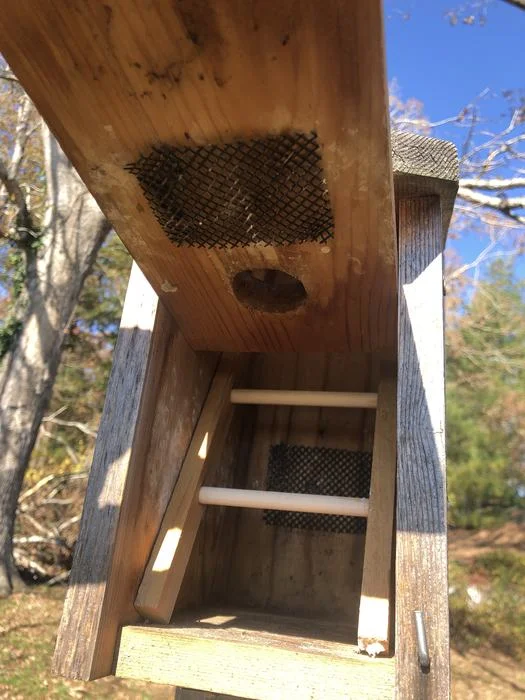
Dimensions vary by plan. Georgia’s version is 10 inches square and 3 feet tall, and the plan below is 12 inches wide and 20 to 26 inches tall. Either way, the perches are thin dowels staggered so no bird sits directly under another. Nobody wants to sleep under a bird that spent the day eating berries.
The evidence for these design details is thin. Bluebird specialists disagree on whether perches are needed, and at least one doubted that bluebirds would use a low entrance at all. None of these sources compares the two designs head to head. A plain nest box with the vents sealed works, and birds do use it.
Who uses them
Bluebirds, chickadees, titmice, nuthatches, and small woodpeckers all use roost boxes. Carolina wrens, flickers, and screech owls roost in cavities too, and blue jays will duck into a box when the weather turns bad.
Not all of them share. Bluebirds often share, and the wrens in that survey did. Chickadees, titmice, nuthatches, and downy woodpeckers usually sleep alone, so a box that holds a dozen birds will mostly host one of them at a time. Downies rarely nest in boxes, but they’ll roost in an unused one just before dusk, and they sometimes enlarge the entrance hole. A hole guard fixes that.
People worry that the birds at the bottom of a pile get smothered. Photos of crowded roosts show birds fanning their heads outward, which suggests they leave themselves air, but that doesn’t settle it. Dead birds do turn up in boxes after severe cold, and Sialis judges food shortage, dehydration, or disease more likely than smothering. Nobody has measured it directly, so treat it as unsettled.
Turn a nest box into a roost box
Start in fall. Clean out the old nest and let the box air out for a few days. Then make these four changes.
- Flip the front panel so the entrance hole sits at the bottom, if your box has a removable front.
- Add perches. Twigs, diagonal sticks, or a small ladder like the one in a chicken coop all work.
- Seal the ventilation holes with duct tape or rolled caulk on the outside only. Leave the drainage holes in the floor open so water can’t pool.
- Put an inch of small wood chips or soft dry grass on the floor. Skip sawdust, cedar bedding, and big chips that can jam in the hole.
If you don’t want to cut anything, skip the flip and the perches. Seal the vents, add the bedding, and you still have a box that holds heat far better than it did in summer.
Build one: materials and measurements
If you want to build from scratch, this plan from Shaw Creek Bird Supplies covers it. It starts with one rough-cut 1 x 12 board, 12 feet long. Cedar lasts longest, and pine or fir work but wear out sooner.

| Piece | Qty | Size (in) | Notes |
|---|---|---|---|
| Back | 1 | 12 x 36 | Score grooves on the inside face between 10 in from the top and 6 in from the bottom. |
| Side | 2 | 26 3/8 on the long edge, 20 on the short edge, 11 wide | The top edge slopes from 26 3/8 down to 20. Drill six 3/8-in pilot holes, 1/4 in deep, on the inside. |
| Top | 1 | 12 x 11 | 15 degree bevel. |
| Front | 1 | 12 x 20 | 15 degree bevel. Grooves on the inside. Entrance hole with its bottom edge 1 1/2 in up. |
| Bottom | 1 | 11 long | Four drainage holes. Sits slightly recessed. Fit the width to the box. |
| Predator guard | 1 | 6 x 6 | Drill a matching entrance hole and glue it on the outside of the front. |
| Perch | 12 | 3 long, 3/8 dowel | Six per side, staggered. Cut from one 3 1/2 ft dowel. |
You’ll also need a 3 1/2-foot hardwood dowel, 3/8 inch thick, wood glue, wood screws, one brass hinge, and a small hook and eye. For tools, use a saw that tilts to 15 degrees, a drill with a 3/8-inch bit, and a hole saw or spade bit for the entrance.
- Bevel the top and front pieces at 15 degrees.
- Cut grooves 1/4 inch deep and 3/8 inch apart across the inside of the front. Score the back the same way, between 10 inches from the top and 6 inches from the bottom. Woodpeckers use them to cling.
- Drill the entrance with its bottom edge 1 1/2 inches above the bottom of the front. The hole size depends on which birds you want in or out, and the plan lists 1 1/2, 2, and 3-inch bits. Glue the predator guard over it, holes lined up, so squirrels and raccoons can’t reach in.
- Drill six 3/8-inch holes, 1/4 inch deep and not through, in the inside of each side piece. Stagger them so no perch sits directly over another. Cut the dowel into 3-inch perches and glue them in.
- Drill four drainage holes in the floor. These stay open, unlike the ventilation holes you seal in a nest box. Screw the sides to the back, set the bottom in slightly recessed, then screw on the front with the bevel at the top.
- Hinge the lid so you can clean the box, and add the hook and eye to hold it shut.
Leave the outside untreated, and never paint or oil the inside.
Where to put it
Mount it 8 to 10 feet up with the entrance facing south or east, away from the prevailing wind. The box should be waterproof and firmly attached. Use a pole with a predator guard, such as a sheet-metal sleeve tacked tight to the pole. It also keeps mice from moving in for the winter.
Put it up before the first hard cold, and leave your nest boxes up all winter either way. Birds usually slip in just before sunset and leave right after sunrise, so watch from a window at dusk. Feathers, droppings, and seed residue inside are the other giveaways.
A roost box covers the sleeping part. For food and water, see our guides to winter feeders and a winter birdbath, and find the rest of our coverage on the birds page.
Sources
- British Trust for Ornithology, Garden Roosting Survey, winter 2010/11.
- Sialis.org, Roosting, Surviving Cold Weather.
- Georgia DNR Wildlife Resources, Terry W. Johnson, Out My Backdoor: Warm Havens for Winter Birds.
- All About Birds (Cornell Lab), Will birds use nest boxes to roost in for warmth during the winter?
- Shaw Creek Bird Supplies via the Ottawa Field-Naturalists’ Club, Winter Roost Box Plans.
- USDA Office of Information, Winter Homes for Birds, press release no. 122, 1936.
- N.C. Cooperative Extension, Henderson County, Steve Pettis, Wildlife Alert: Winter Roosting Boxes for Birds, 2024.