There’s a small but thriving industry of decorative toad houses — ceramic mushroom-shaped things, hand-painted cottages with little windows, whimsical stone caves — and most of them sit empty forever. The toad they’re meant to house is either not there or not interested. The ceramic isn’t the problem. The yard usually is.
Attracting toads to a garden is less about adding features and more about the environment you let develop. The yards where toads actually show up and stay tend to look less polished than the yards where they don’t. That’s the real trade-off, and it’s worth naming up front.
Why you’d want toads in the first place
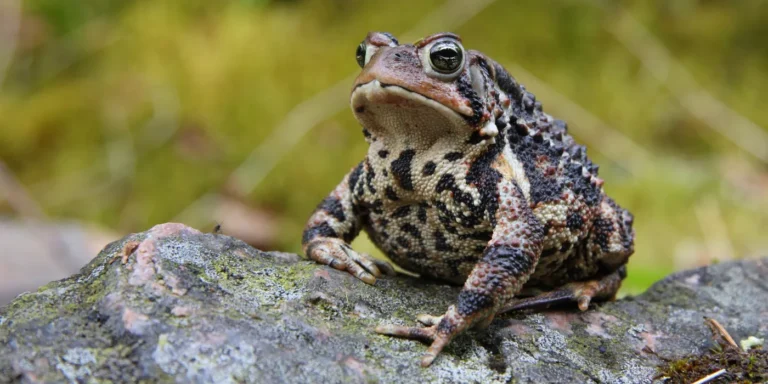
The short version is pest control on a scale that’s genuinely impressive. A single American toad can eat an estimated 10,000 insects and other invertebrates over the course of a summer — slugs, beetles, cutworms, earwigs, grubs — the entire list of things most gardeners would otherwise try to manage with chemicals. Multiply that across a few resident toads and you’re looking at meaningful garden defense that costs nothing and asks for nothing beyond not poisoning your yard.
It’s also worth knowing that amphibians are in real trouble. The 2023 Global Amphibian Assessment published in Nature found that 40.7% of amphibian species are now threatened with extinction, making them the most imperiled vertebrate class on Earth. USGS data shows amphibian populations in the U.S. declining at an average rate of 3.79% per year — a pace that, if it holds, will erase many species from half their habitats within about twenty years.
That’s a heavy way to open an article about a garden feature. But it’s the honest frame. When you make a yard hospitable to toads, you’re not just getting free pest control. You’re offering habitat to a class of animals losing habitat everywhere else. Those are much bigger stakes than a ceramic cottage suggests.
What most people get wrong
The mistake is treating “attracting toads” as a checklist — buy the house, fill the water dish, wait. Toads don’t read checklists, and they’re extremely particular about what a yard actually provides.
Toads need three things, roughly in order: food (a healthy insect population), moisture and shelter (damp, shady hiding spots where their skin doesn’t dry out), and water for breeding (shallow, fishless). If any one of those is missing, the toad house is irrelevant. If all three are present, you probably don’t need to buy anything at all.
The yards that attract toads tend to share a few traits: patches left a little messy, leaf litter under shrubs, no broadcast chemicals, dense low plantings, and some source of moisture. The yards that don’t attract toads usually have the opposite — tight lawn edges, chemically treated turf, bagged-and-hauled leaves, and a garden-center toad house next to a bone-dry bed.
The things that actually matter
1. Stop treating your yard with chemicals
This is the single most important step, and it’s also the one people are most reluctant to fully commit to. Toads absorb water and chemicals directly through their skin, which makes them extraordinarily vulnerable to pesticides, herbicides, and synthetic fertilizers — even at levels that wouldn’t register as a problem for most animals. A yard that relies on routine chemical treatment is a yard toads won’t populate, no matter how good the habitat features look.
Bug zappers and mosquito foggers fall into the same category. Bug zappers kill almost no mosquitoes and mow down enormous numbers of beneficial insects instead, including the exact insects toads eat. A yard that wants toads is a yard that lets insects live, including the ones you may not personally love. The toads handle the actual pest problems. That’s the whole exchange.
2. Leave the leaves
Toads shelter under leaf litter, damp mulch, and whatever low cover exists between the mowed lawn and the fence. The instinct to bag up every fallen leaf in October is exactly the opposite of what a toad needs. Ecologists have been increasingly vocal about how much backyard wildlife depends on leaf litter, and toads are one of the clearest examples. A few inches of leaves left under shrubs and around the edges of beds is functional shelter. It’s also free.
If leaving your whole lawn under leaves isn’t something you want to do, the compromise is to leave them in bed edges, under shrubs, and in corners — the places toads actually use — and deal with the lawn however you prefer.
3. Add a shallow water source
Toads don’t drink water; they absorb it through their skin. What they need is a shallow, stable source they can climb into and out of easily. A terra cotta saucer sunk flush with the ground and filled with clean, unchlorinated water does the job. Tap water should sit out overnight before being added, to let the chlorine dissipate.
For breeding, the requirements are different. Toads lay eggs in water, and they need a pond or large puddle that holds long enough for tadpoles to develop — roughly two months. A wildlife pond doesn’t have to be big: about 2 to 3 feet across and 6 inches deep, left free of fish, will work. Fish eat tadpoles. A breeding pond with goldfish in it is a decorative feature, not amphibian habitat.
4. Build actual shelter
This is where the toad-house industry goes wrong. The functional version of a toad shelter is an overturned terra cotta flowerpot, one edge propped on a stone to create an entrance, set in a shady spot against plant cover. A small cairn of rocks with gaps at the base works too. Penn State Extension has a straightforward write-up of the design, and it’s exactly as simple as it sounds.
The ornamental toad houses sold at garden centers are fine if you like how they look. But they don’t generally offer anything a broken flowerpot doesn’t, and the broken flowerpot has the advantage of being free.
5. Think about outdoor lighting
Toads are nocturnal, and they hunt the flying insects that gather around outdoor lights. A porch light or low-placed garden light near good toad shelter can actually increase their hunting success — one of the few cases where artificial lighting helps rather than harms wildlife. The caveat is that broader yard lighting, landscape floodlights, and bright security fixtures disrupt more species than they help. Wildlife-friendly yard lighting — warm colors, motion-activated, pointed downward — gives toads usable hunting conditions without scrambling the rest of the nocturnal ecology.
A note on touching toads
The old belief that touching toads causes warts is not true. The bumps on a toad’s skin are glands, not warts, and the secretions they produce are a defense against predators, not a human skin condition.
The concern actually runs the other direction. Toad skin is extremely permeable, which means sunscreen, bug spray, hand lotion, and leftover soap on human skin can transfer directly into the toad. If you need to move a toad out of genuine danger — off a driveway, out of a pool — wet your hands first in clean water, handle gently, and set it down in a shady, moist spot nearby. Otherwise, admire from a distance. They’re not pets.
What this looks like in a real yard
A yard that attracts toads tends to have: a couple of shaded corners with leaf litter left in place, no insecticide or herbicide routine, a shallow ground-level water source kept filled with clean water, dense lower plantings (native perennials, groundcovers, shrubs with skirted bases), and at least one cool, dark shelter — even if it’s just a broken flowerpot tipped into the corner of a bed.
If there’s water within a reasonable distance for breeding — your pond, a neighbor’s, a seasonal wetland, a drainage ditch — toads will often find you without any deliberate effort on your part. As Oregon State Extension points out, amphibians routinely travel long distances over land, sometimes several miles, and they’ll settle into habitat that meets their needs. You don’t have to catch one. You have to build the kind of yard they’re already looking for.
Frequently asked questions
Can I buy toads for my garden? No, and you shouldn’t try. Commercially sold toads are often non-native species that shouldn’t be released, and moving native toads from other places disrupts local populations, can spread disease, and usually fails anyway — they tend to try to return to where they came from. Build the habitat. Local toads will find it.
How long do toads live? Longer than most people expect. American toads can live 10–15 years in the wild under good conditions, and they tend to return to the same yards year after year. A resident toad is often a multi-year resident.
Will toads harm my pets? American toads secrete a bitter, mildly toxic substance from skin glands as a defense. It can make a dog sick if it mouths a toad, though usually not seriously. Cane toads in Florida and Hawaii are a much more significant risk. Training dogs to leave toads alone is the reasonable precaution across most of North America.
Do I need a pond to have toads? Not strictly — adult toads will use your yard for shelter and feeding even if they breed in water several hundred yards away. But if you want a stable breeding population, nearby water that holds for at least two months in spring is the thing that changes the equation.