You can plant the perfect “dragonfly-friendly” flower bed and not see a single dragonfly show up. Plants alone don’t attract them. Water does. The right plants help — some of them a lot — but they work because of their relationship to water, not in place of it.
If that feels like moving the goalposts, stay with me. The real answer to this question is more useful than a list of flowers, and it’s also what separates a yard where a dragonfly shows up once a summer from a yard where they actually breed.
Why the “plants for dragonflies” framing is a little off
Dragonflies spend most of their lives underwater. The shimmering adult zipping around a pond on a July afternoon has already lived one to five years — sometimes longer, depending on the species — as an aquatic nymph, breathing through gills and hunting tadpoles, mosquito larvae, and other small invertebrates in pond-bottom muck. Adults only live a few weeks to a few months. The rest of the life cycle happens in water.
That changes what “attracting dragonflies” actually means. You’re inviting a predator whose entire life cycle depends on stable, pesticide-free freshwater for its young to grow up in.
If you have water — a small garden pond, a rain-holding depression, a livestock trough left to go wild — the right plants dramatically increase what dragonflies get from it. If you don’t have water, plants alone won’t bring a breeding population, though they can still support adults that are hunting in your yard after breeding somewhere else.
The plants that actually matter, grouped by job
Useful plants for dragonflies fall into two groups that work together: plants in or at the edge of water, and plants nearby that support the prey insects dragonflies eat.
Emergent aquatic and wet-soil plants
These are the real workhorses. Roots sit in water or saturated soil; stems and leaves rise above the surface. They do two critical things at once: their submerged parts give nymphs cover and hunting grounds, and their vertical stems give mature nymphs something to climb on when it’s time to molt into adults. Without those emergent stems breaking the surface, the whole emergence process gets harder. Some species just can’t complete it.
The standouts in North America:
- Pickerelweed (Pontederia cordata) — Tall purple flower spikes, emergent leaves, thrives at shallow pond edges. Attracts dragonflies as reliably as any single plant I can recommend.
- Blue flag iris (Iris versicolor, Iris virginica) — Upright sword-shaped foliage makes a near-perfect perch for hunting adults. Wet soil or shallow water.
- Arrowhead (Sagittaria latifolia) — Distinctive arrow-shaped leaves, white flowers, tolerates variable water depths.
- Soft rush and other Juncus species — Plain-looking, genuinely essential. Those vertical stems are exactly what nymphs climb.
- Native broadleaf cattail (Typha latifolia) — Common for good reason. Just make sure you’re not accidentally planting the invasive narrowleaf or hybrid cattails, which can dominate a small pond fast.
- Buttonbush (Cephalanthus occidentalis) — A native wetland shrub with spherical white flower clusters. Attracts dragonflies indirectly by pulling in the small insects they prey on.
Wet-meadow and pondside plants
These do the secondary work — perches for hunting adults, and fuel for the broader insect community dragonflies feed on.
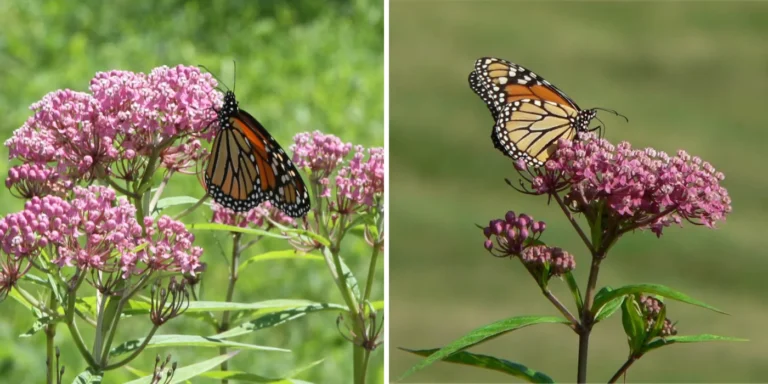
- Swamp milkweed (Asclepias incarnata) — Native, wet-tolerant, attracts the small flying insects dragonflies hunt. It’s also one of the better monarch butterfly plants — different insect entirely, but worth knowing if you’re planning a broader pollinator-and-pond setup.
- Joe Pye weed (Eutrochium spp.) — Tall, architectural, and a favorite landing spot for larger dragonfly species.
- Cardinal flower (Lobelia cardinalis) — Wet-soil lover, brilliant red, supports the insect community around water.
- Meadowsweet (Spiraea alba) — Native wet-tolerant shrub. Pulls in flies and small pollinators that end up on dragonfly menus.
If you don’t have water
This is the honest limit of a plant-based approach. Without water, you’re not going to get breeding dragonflies. You can still support adults breeding somewhere nearby — a neighbor’s pond, a roadside ditch, a seasonal wetland — by planting things that attract their prey and by giving them perching structure.
Tall native perennials and grasses work well here. Joe Pye weed, ironweed, switchgrass, native asters. Dragonflies are visual hunters that use elevated perches to spot flying insects, so any structure that rises above surrounding vegetation — a tall stem, a garden stake, a dried seed head left standing into fall — functions as a hunting platform.
Adding even a small water feature changes the whole equation. You don’t need a proper pond. A livestock tank or half-barrel planted with a couple of rushes and some pickerelweed, left to stabilize into its own little ecology over a season, can attract breeding dragonflies in a surprisingly short time. Small is fine. What matters is that the water stays, doesn’t freeze solid in winter, and isn’t treated with anything.
The mosquito connection people usually get backwards
Dragonfly nymphs are voracious predators of mosquito larvae. A healthy pond population handles a genuinely impressive amount of mosquito control that would otherwise require chemicals, sprays, or devices with ugly side effects. And this is where most people’s pest-control instincts actively work against the outcome they actually want.
Bug zappers are the most visible example. Their real ecological cost is well-documented: they kill almost no mosquitoes and mow down vast numbers of beneficial insects instead, including the exact flying insects adult dragonflies feed on. Mosquito foggers do the same damage across a larger footprint. Both reduce the prey base dragonflies depend on while failing at the job they were bought to do.
If you want dragonflies, the most important thing you can stop doing is often as valuable as anything you plant. No broadcast insecticides, no bug zappers, no fogging. Let the insects that aren’t bothering you live, and the ones that do bother you — mosquitoes especially — tend to get eaten.
What this looks like in a real yard
The lowest-effort version: a small in-ground pond or half-barrel water feature, planted with three or four native emergent plants — pickerelweed, a couple of rushes, maybe a blue flag iris — surrounded by a clump of native wet-tolerant perennials like swamp milkweed and Joe Pye weed, and left alone. No chemicals, no aggressive cleaning, no fish. (Fish eat dragonfly nymphs and tilt the ecology in the wrong direction for this particular goal. Goldfish are especially bad.)
Within a season or two, if there’s a breeding population within flight range, you’ll start seeing adults patrolling the yard. Within a few seasons, you’ll often see the molted skins of emerged nymphs — pale, ghostly, clinging to iris leaves and rush stems. That’s the sign your water isn’t just attracting dragonflies but producing them.
That shift, from hosting dragonflies to producing them, is really the whole point.
Frequently asked questions
Do dragonflies eat mosquitoes? Yes. Adults eat flying mosquitoes, and nymphs are major predators of mosquito larvae. A pond with a healthy dragonfly population suppresses mosquito numbers considerably.
Will dragonflies come if I only have a birdbath? Not for breeding. A birdbath is too small and too disturbed to support nymph development. You may get occasional perching visits from adults, but it’s not dragonfly habitat.
Do I need fish in my pond to attract dragonflies? The opposite, actually. Fish — goldfish and mosquitofish especially — eat dragonfly nymphs and reduce both the breeding population and the insect community that supports them. A wildlife pond without fish supports far more dragonflies.
Can I attract dragonflies without a pond? To some extent. Adults will hunt in yards with good perching plants and healthy insect populations, as long as water exists somewhere within their range. True dragonfly habitat — where they breed, emerge, and stick around all season — requires water.
Are cattails a problem? Native broadleaf cattail (Typha latifolia) is fine in small wetland plantings, though it spreads. The narrowleaf and hybrid cattails are aggressive and can take over a pond. Check the label before buying.