Swamp Milkweed: The Milkweed That Actually Belongs in Most Gardens
- Give A Shit About Nature
- May 14, 2026
- Milkweed, Native Plants
- 0 Comments
The conversation around planting milkweed for monarchs has produced something that was probably inevitable: a huge amount of people doing the right thing for the wrong reason, with the wrong plant.
Walk into any garden center in spring and you’ll find tropical milkweed (Asclepias curassavica) stacked prominently near the entrance, bright orange-and-red flowers, vigorous and easy. Monarchs will land on it. Caterpillars will eat it. For a first-time gardener trying to help, it looks like success.
The problem is that tropical milkweed, depending on where you live, can actively harm the monarchs it attracts — and that swamp milkweed (Asclepias incarnata), which is available from native plant nurseries and handles conditions that butterfly weed can’t, is the species the majority of gardens should actually be growing.
This is a story about what happens when conservation demand meets retail convenience, and what one specific native plant reveals about the difference between good intentions and good outcomes.
The Tropical Milkweed Problem
Tropical milkweed is not native to North America. It originates in Central and South America and was introduced as an ornamental. It’s popular with growers because it’s easy to propagate, blooms prolifically, and sells. It’s popular with buyers because it attracts monarchs visibly and immediately.
The problem is what happens when it doesn’t die back in winter. In temperate states where frost kills the plant annually, tropical milkweed functions as an annual and the seasonal dieback resets the system.
But in areas with mild winters — most of Florida, coastal regions of the Gulf South, parts of California — tropical milkweed can persist year-round, and that persistence creates a build-up of Ophryocystis elektroscirrha, or OE: a protozoan parasite that travels with monarchs, deposits spores on milkweed leaves, and is ingested by caterpillars feeding on those leaves.
High OE levels in adult monarchs are linked to lower migration success, reductions in body mass, lifespan, mating success, and flight ability. Infected caterpillars that do survive may produce adults with deformed wings or inability to emerge from their chrysalis. Because native milkweeds die back seasonally, the OE parasite dies with the plant material. Tropical milkweed that persists through winter accumulates spore load across generations.
A peer-reviewed 2015 study by Satterfield et al., published in Proceedings of the Royal Society B and extensively cited by the Monarch Joint Venture, found clearly that monarchs breeding on tropical milkweed in winter had higher OE infection rates than monarchs in the migratory cycle. The Monarch Joint Venture’s own Q&A on this research frames it precisely: “This result is not debatable.” The implications for population-level impact are more complex, but the infection pattern itself is established.
In June 2025, Florida added tropical milkweed to its statewide invasive species list. UF/IFAS Extension Hillsborough County now recommends removing tropical milkweed and replacing it with native species including swamp milkweed.
Why Swamp Milkweed Fits Where Butterfly Weed Doesn’t
Most native milkweed coverage leads with butterfly weed (Asclepias tuberosa), which is beautiful and legitimate and worth growing — but it requires sharply drained, even sandy soil, does not tolerate wet conditions, and will rot in the heavy clay or consistently moist beds that describe a large percentage of suburban yards. Butterfly weed in the wrong conditions is a failure waiting to happen.
Swamp milkweed occupies the opposite ecological niche. It evolved in wet meadows, stream margins, and low areas with consistent moisture, and it tolerates conditions that butterfly weed categorically cannot. Clay soil, rain garden edges, spots near downspouts, seasonally flooded zones — these are where swamp milkweed performs without complaint. UF/IFAS specifically identifies it as a great choice to plant near a downspout, by a pond, or in a low spot in your landscape.
This is the practical argument for swamp milkweed that gets undersold: it solves a siting problem that butterfly weed creates. A gardener with a wet corner who plants butterfly weed out of inertia — because that’s the milkweed they’ve heard of — ends up with a dead or struggling plant. A gardener who plants swamp milkweed in that same corner has a robust, blooming host plant that comes back reliably year after year.
It also handles partial shade better than butterfly weed, extending the viable planting locations further into the kinds of conditions most suburban yards actually have.
What It Actually Does for Monarchs
Swamp milkweed is a full monarch host plant. Monarchs lay eggs on the leaves, caterpillars feed and develop on the foliage, and the plant supports the complete larval cycle. Swamp milkweed has naturally lower cardenolide levels than tropical milkweed, the cardiac glycosides in milkweed are what make monarchs toxic to predators, and while some level is important, extremely high concentrations can be harmful to caterpillars. Swamp milkweed sits in a range that supports development without the spikes in cardenolide concentration observed under warming conditions with tropical milkweed.
Beyond monarchs, swamp milkweed supports a broader community of insects than people typically realize. Our overview of native milkweed and who’s using it covers the full roster: milkweed tussock moth caterpillars (native, no action needed), large milkweed bugs, oleander aphids, milkweed beetles. A milkweed plant that’s covered in insects is a functioning host plant, not a problem to solve. The ecosystem around milkweed is considerably richer than the monarch-exclusive framing suggests.
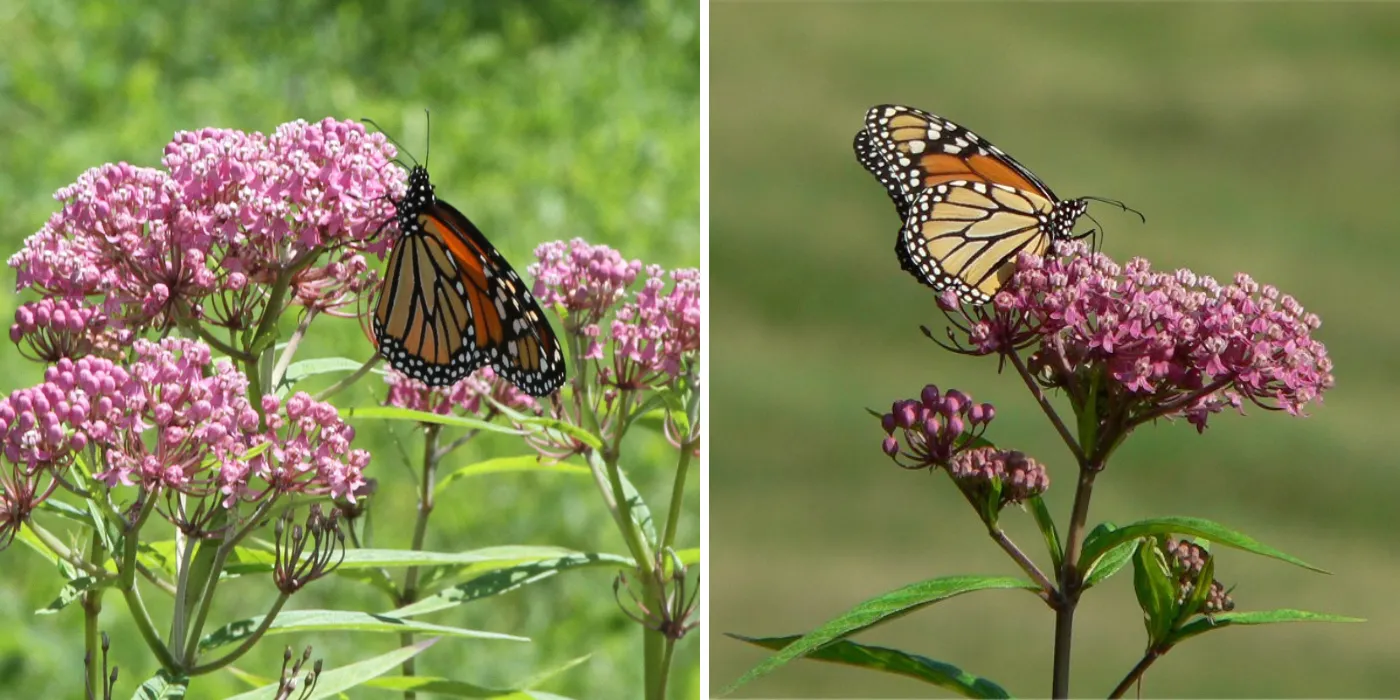
Adult swamp milkweed blooms are also valuable nectar sources for a range of pollinators — the pink flower clusters attract swallowtails, native bees, and other butterflies in addition to serving the monarch larval cycle. This dual function as both host plant and nectar source is ecologically more useful than a plant that only does one of those things.
Growing It Well
Swamp milkweed wants moisture and sun, and it’s relatively uncomplicated once you match the site correctly. In consistently moist soil with reasonable organic content, it establishes without difficulty and spreads gradually by root over time. It can handle short periods of flooding and recovers from dry spells better than its wet-site preference might suggest, though it performs best where moisture is consistent.
The one adjustment worth making in average garden soil is organic matter. Swamp milkweed evolved in the rich organic soils of wetland margins, and adding compost to the planting area helps it settle into drier conditions. In genuinely wet spots, no amendment is needed.
It dies back completely in fall, which is exactly the point. That seasonal dieback eliminates the OE parasite reservoir that persisting tropical milkweed maintains. The rosette regrows from the root system in spring, usually later than you expect — swamp milkweed is a genuine wait-for-it plant in spring, often not showing above ground until the soil warms in May. Digging it up because it hasn’t appeared by April is a common mistake. Mark the spot and leave it alone.
Leaving the standing stalks through winter serves the same purpose it does for most native perennials: hollow stems shelter cavity-nesting bees, and the seed heads provide some winter bird interest. Cut it back in late spring once new growth is visible at the base.
Swamp Milkweed In The Broader Milkweed Picture
Swamp milkweed belongs in a planting strategy that includes more than one milkweed species. Our article on monarch habitat and what native plants monarchs actually need covers the complete picture: milkweed provides the larval food source, but adult monarchs need a diverse, season-long nectar supply throughout their migration corridor.
Goldenrod, native asters, and ironweed are among the most important late-season nectar sources for southbound monarchs. A yard with milkweed for caterpillars and nothing for adult migration is doing half the job.
The milkweed species to combine with swamp milkweed depends on your site. Butterfly weed handles the dry, sunny spots. Common milkweed (Asclepias syriaca) spreads aggressively but is ecologically important and appropriate for wilder edges and meadow settings.
We’ve also written about growing milkweed in containers for gardeners without in-ground planting options. The goal is regional diversity — multiple species with different site tolerances, blooming across an extended period, located along the migration corridor where monarchs actually travel.
The larger point is that planting for monarchs is not the same as planting a single tropical milkweed from a gas station parking lot. It requires understanding which milkweed species fit which conditions, which species avoid the OE problem, and what else the garden needs to do beyond providing larval food.
Swamp milkweed is frequently the best answer to the most common site conditions most people have — wet corners, heavy soil, partial shade. The fact that it also avoids the parasitism problem built into tropical milkweed makes it not just practical, but ecologically safer than the alternative most garden centers are still selling.
Growing Reference
- Native range: Eastern and central North America, from the Atlantic coast to the Great Plains, and into parts of the Southeast and Southwest.
- USDA hardiness zones: 3–6 in most of its range; performs in zones 3–9 with appropriate moisture.
- Height: Typically 3–5 feet; can reach 6 feet in optimal conditions.
- Bloom time: June through August, with regional variation.
- Light: Full sun to part shade; tolerates more shade than most milkweeds.
- Soil: Moist to wet, tolerates clay; does not tolerate drought.
- Water: Consistent moisture preferred; excellent for rain gardens, pond margins, and low spots.
- Propagation: Seed (cold stratification recommended for best germination), division of established clumps in early spring.
- Notable cultivars: ‘Ice Ballet’ (white flowers), ‘Cinderella’ (deep pink) — straight species preferred for maximum ecological fidelity.
FAQ
Why is swamp milkweed better than tropical milkweed? Swamp milkweed is native to North America, dies back seasonally which breaks the OE parasite cycle, and has been shown to have more stable cardenolide levels than tropical milkweed under warming conditions. Tropical milkweed that persists year-round in mild climates accumulates OE spore loads that can harm monarchs across successive generations.
Can swamp milkweed grow in a dry garden? It’s better suited to moist conditions than dry ones, but with organic matter incorporated into the soil and mulch to retain moisture, it can establish in average garden beds. Butterfly weed (A. tuberosa) is the better choice for genuinely dry, well-drained sites.
Is swamp milkweed invasive? No. It spreads gradually by root over time and may expand a planting area, but it’s not aggressive in the way common milkweed (A. syriaca) can be. It’s easy to manage in a garden setting.
When does swamp milkweed emerge in spring? Later than most perennials. Don’t assume a plant has died if it hasn’t broken dormancy by May. Mark the location and wait — swamp milkweed emerges reliably once the soil warms.
Should I deadhead swamp milkweed? Leaving seed pods to ripen and disperse naturally extends the planting over time. Deadheading redirects energy into the root system but reduces self-seeding. Either approach is fine depending on whether you want the planting to spread.