Milkweed Laws Explained: When Growing It Breaks The Law
- Give A Shit About Nature
- May 14, 2026
- Milkweed, Native Plants
- 0 Comments
Milkweed is not illegal to grow in most of the United States. That’s the short answer, and for the vast majority of homeowners and gardeners in most states, it’s the complete answer.
The more interesting story is why people are searching for this question in the first place — because there’s a real, legitimate legal history here that got oversimplified in both directions. Some states did list common milkweed as a noxious weed, mostly to protect agricultural cropland.
Some still technically do. And a handful of HOA ordinances and municipal codes have complicated things further. But the direction of change over the past decade has been strongly toward removing milkweed from these lists and explicitly protecting it, driven by recognition that monarch butterfly recovery depends on it.
Here’s what’s actually going on, and what you need to know before you plant.
Why Milkweed Was Ever Restricted
The classification of common milkweed (Asclepias syriaca) as a noxious weed in certain states goes back to its behavior in agricultural settings. Common milkweed spreads aggressively through underground rhizomes and can colonize crop fields, roadsides, and managed land in ways that create real problems for farmers. It also contains cardiac glycosides that are toxic to livestock in large quantities, which historically raised concerns in regions with significant grazing.
Iowa listed common milkweed as a noxious weed since the mid-20th century. Some Ohio counties regulated it near croplands. Illinois had regional bans that weren’t lifted until 2017. These weren’t laws designed to stop conservation gardeners — they were agricultural nuisance regulations aimed at preventing invasive spread into managed land. That context matters because it’s what the laws were actually about.
The problem is that “noxious weed” sounds like “dangerous illegal plant,” and that interpretation spread far beyond the agricultural contexts where the regulations applied. Homeowners began assuming milkweed was categorically prohibited, stopping them from planting something that’s ecologically critical.
Where Milkweed Is Now Protected
The trend line runs clearly in one direction. The Monarch Joint Venture documents numerous cities and states that have removed milkweed from noxious weed lists, including Toledo, Ohio, the state of Illinois, and others. Michigan passed a law in 2024 that explicitly states “noxious weeds does not include milkweed.” The Michigan legislation was a direct response to recognition that milkweed protection and monarch recovery are inseparable goals.
Minnesota, once known for relatively strict regulation, now actively encourages milkweed planting in pollinator corridors and public landscapes. New York and California have both launched milkweed distribution programs to support monarch recovery. The regulatory environment has shifted significantly, what was once a patchwork of agricultural restrictions is increasingly a landscape of conservation encouragement.
None of this means every jurisdiction has caught up. Iowa’s technical listing of common milkweed as a noxious weed has not been formally removed, though enforcement is minimal and focused on agricultural contexts rather than residential gardens. Some county-level regulations persist in states where the state law has changed.
The Monarch Joint Venture’s position is that garden use is generally not the target of these regulations, but verifying with your local extension office or state department of agriculture is the reliable way to know your specific situation.
The One Species That Is Getting Restricted
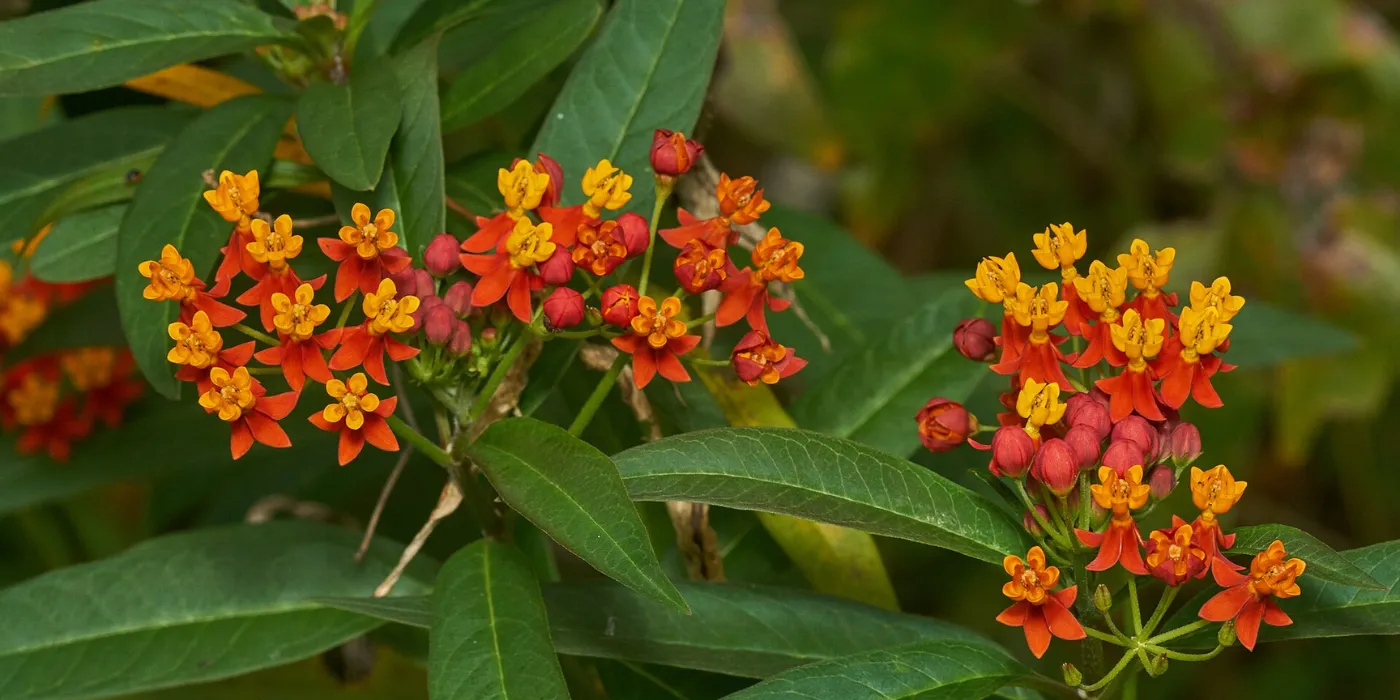
While native milkweed is increasingly protected, tropical milkweed (Asclepias curassavica) is moving in the opposite direction, and for legitimate reasons.
UF/IFAS added tropical milkweed to Florida’s invasive species list in June 2025, now classified as a Category II invasive. The problem is that tropical milkweed doesn’t die back in Florida’s climate, allowing the OE parasite (Ophryocystis elektroscirrha) to accumulate on leaves across generations and infect successive cohorts of monarch caterpillars. As our full piece on swamp milkweed explains, native milkweed’s seasonal dieback naturally breaks the parasite cycle that tropical milkweed sustains year-round.
This isn’t a technicality. Infected monarchs develop deformed wings, fail to emerge from their chrysalis, or produce adults too weak to migrate. The Xerces Society describes it as a “no-grow” for warmer regions where it persists through winter.
So the legal picture for milkweed in 2025 looks roughly like this: native species are broadly encouraged and increasingly explicitly protected; tropical milkweed is increasingly restricted in warmer states. The conservation community and the regulatory trend are pointing in the same direction.
HOA Rules Are a Separate Problem
State law and HOA rules are different things, and HOA restrictions on plant height, “weediness,” or specific species can apply even where state law is permissive. Many milkweed-related complaints aren’t about state law at all, but more about homeowners’ associations treating native plants as violations of landscaping standards.
Your garden is not automatically protected from HOA guidelines because it contains pollinator habitat. If your HOA restricts plant height or requires manicured appearances, milkweed may technically be in conflict with those rules regardless of what state law says.
The practical path, per Monarch Joint Venture, is advocacy: getting milkweed specifically exempted, requesting a pollinator habitat certification that provides some protection, or working to change HOA landscaping guidelines from within. None of that is quick, but it’s the route that actually works.
What to Check Before You Plant
For most people reading this, the practical steps are simple. Check your state’s department of agriculture noxious weed list. Most are searchable online. If common milkweed appears, read the specific language: it’s almost certainly targeted at agricultural or roadside management rather than residential gardening. If you’re uncertain, call your local university extension office, which is the fastest path to an accurate answer for your county.
If you have an HOA, check your landscaping guidelines specifically for plant height restrictions or lists of prohibited plants. If milkweed isn’t explicitly prohibited, you’re likely fine. If it is, or if there’s a general “no weeds” provision, that’s worth addressing proactively before you plant rather than after.
The species selection question is also worth thinking about before buying. Native milkweed species are far better for monarchs than tropical milkweed, and three of the most common native species handle very different site conditions.
Butterfly weed (Asclepias tuberosa) for dry, well-drained soil. Swamp milkweed (Asclepias incarnata) for wet or moist spots. Common milkweed (Asclepias syriaca) for wilder edges where its spreading habit has room to work. Matching species to site is the difference between a milkweed planting that establishes and one that struggles. We’ve also written about growing milkweed in containers if in-ground options are limited.
The regulatory barrier to planting milkweed has largely dissolved. The practical barrier is often just knowing that.
Read More: Native Plants That Attract Monarch Butterflies — Milkweed Alone Isn’t Enough
FAQ
Is it illegal to grow milkweed in my state? For most states, no. Native milkweed species are broadly legal for residential gardening. Some states technically list common milkweed (Asclepias syriaca) as a noxious weed in agricultural contexts, but enforcement is typically aimed at cropland and roadsides rather than home gardens. Check your state’s department of agriculture noxious weed list to be certain.
Is tropical milkweed illegal? It’s now classified as a Category II invasive species in Florida as of June 2025. Other warmer states may follow. Outside Florida, it’s typically not prohibited but is strongly discouraged by conservation organizations due to the OE parasite problem. Native milkweed species are the better choice regardless.
Can my HOA restrict milkweed? Yes. HOA rules operate separately from state law. Review your HOA landscaping guidelines and, if milkweed is restricted, pursue an exemption or work to change the guidelines through your HOA’s amendment process.
What native milkweed species should I plant? It depends on your site conditions. Butterfly weed for dry, sunny spots. Swamp milkweed for wet or moist conditions. Common milkweed for naturalized edges with room to spread. All three are native hosts for monarchs; tropical milkweed should be avoided in regions where it doesn’t die back in winter.