Possum vs. Opossum: Both Are Correct, But Not for the Same Animal
- Give A Shit About Nature
- May 14, 2026
- Opossums, Wildlife
- 0 Comments
Wait, is it possum or opossum? Both are correct. Which one applies depends entirely on which animal you’re talking about, and most people in North America are casually using the wrong one without knowing it.
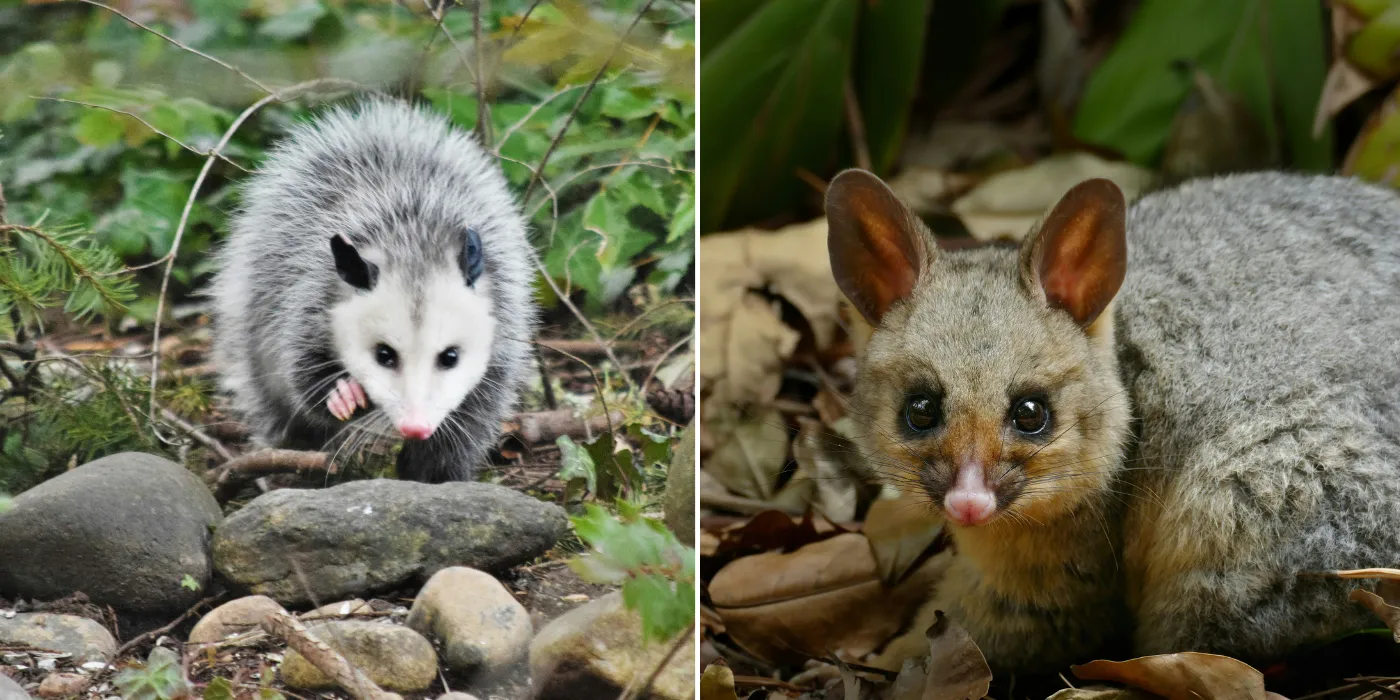
The animal most Americans encounter in their yards, the one that plays dead, hisses dramatically when startled, and occasionally raids the compost, is technically an opossum. Its formal common name is Virginia opossum (Didelphis virginiana), and “opossum” is what naturalists, state wildlife agencies, and scientific literature use for any member of the order Didelphimorphia, all of which are native to the Americas.
“Possum,” the informal version that most Americans use in everyday speech, is actually the correct common name for an entirely different group of animals: the possums of Australia and nearby regions, which belong to the order Diprotodontia. They’re marsupials like opossums, but they’re not closely related. Different continents, different evolutionary history, different animals.
So when someone says “there’s a possum in my garbage,” they’re probably talking about a Virginia opossum, using a shortened nickname that technically belongs to a different species on the other side of the world. Language is strange.
Why Both Names Are Used for the North American Animal
When European settlers named the animals they found in the New World, they were working fast and with imperfect reference points. Captain John Smith documented the Virginia opossum in the early 1600s, using a word derived from the Algonquian aposoum, meaning “white animal.” The initial transcription was “opassom,” and it eventually settled into “opossum.”
The “o” at the beginning of the word gets dropped in casual speech pretty naturally — English speakers do this constantly with words over time, and regional accents accelerate it. In the American South especially, “possum” has been the colloquial standard for generations. The Merriam-Webster dictionary lists “possum” as a valid informal variant of “opossum” specifically in reference to the North American animal.
So in practical, everyday American English, calling the Virginia opossum a possum is completely understandable and you won’t confuse anyone. In scientific and wildlife management contexts, “opossum” is the appropriate term.
What They Actually Are (And Why They’re Worth Understanding)
Virginia opossums are the only marsupial native to North America north of Mexico. That alone makes them remarkable. They’re more closely related to kangaroos and wallabies than to any placental mammal, and they’ve been doing their thing on this continent for roughly 65 million years, which means they survived whatever finished off the non-avian dinosaurs. They’re genuinely ancient animals, and the whole “playing dead” strategy predates most of their current predators by a wide margin.
The playing dead behavior, called thanatosis, is involuntary. The opossum doesn’t decide to do it — it’s an autonomic response to extreme stress, similar to fainting. The animal goes limp, its breathing slows, it drools, and it emits a foul-smelling secretion from its anal glands to reinforce the impression of a rotting corpse. Some predators lose interest; the opossum eventually recovers when the threat passes.
We’ve written more fully about opossum behavior and why their aggressive reputation is wrong. The hissing and drooling that looks threatening is almost always defensive performance rather than genuine aggression.
The Australian Possums: A Different Animal Entirely
For completeness: Australian possums are genuinely different. There are more than 60 species in Australia, New Zealand, and nearby regions, ranging from the common brushtail possum to the tiny pygmy possum. They’re adapted to arboreal life, eat mostly vegetation and nectar, and tend to look considerably more appealing to most people than the Virginia opossum, which may be part of why the informal “possum” name became attached to the American animal, since early European settlers were trying to describe something familiar.
The naming confusion runs in both directions. In Australia, people casually refer to their possums using that name without any confusion, because they don’t have opossums. In North America, people casually drop the “o” without issue because they don’t have the Australian possums. The overlap exists only when someone is trying to be precise across both contexts.
The Wildlife Perspective on This Animal
Whatever you call it, the Virginia opossum is useful to have around. We’ve written about all the reasons opossums are good to have in a yard, their role as scavengers, their tick-foraging behavior, their notably low rabies risk relative to other wildlife. They fill a genuine ecological niche as generalist omnivores and decomposer-adjacent scavengers, and their low body temperature makes them significantly less dangerous from a disease transmission standpoint than raccoons, skunks, or foxes.
Their reputation suffers mostly because they look alarming to people who startle them, and because the defensive behavior (hissing, teeth-baring, drooling) reads as aggression even when it’s the opposite. What to do when you see an opossum is genuinely simple: leave it alone, give it time, and it will move on.
If you find one apparently dead in the yard, give it 30 minutes before drawing conclusions. Thanatosis can last anywhere from a few minutes to several hours. The animal that looks dead at 8 p.m. may be gone without a trace by midnight.
FAQ
Is it incorrect to say “possum” in North America? In casual conversation, no — it’s widely understood and used, especially in the South. In formal, scientific, or wildlife management contexts, “opossum” is the appropriate term. Merriam-Webster accepts “possum” as an informal variant.
Are possums and opossums the same animal? No. Opossums are marsupials of the order Didelphimorphia, native to the Americas. Possums are marsupials of the order Diprotodontia, native to Australia, New Zealand, and nearby regions. They share a marsupial ancestry but are not closely related.
Is “playing possum” named after the right animal? The phrase is named after the North American Virginia opossum, even though it uses the informal “possum” name. The behavior it describes — feigning death — is accurately attributed to the opossum and is well-documented.