This time of year, people start wondering why so many ladybugs are trying to get into their windows. Here’s the thing: those aren’t the ladybugs you grew up with. They’re Asian lady beetles, an invasive pest from Asia, and your house is where they want to spend the winter.
You won’t get rid of all of them this year. The beetles already in your walls and attic will keep wandering out on warm days until spring, and insecticide used indoors tends to be ineffective against them. Vacuum the ones you can see, and expect more.
They won’t breed in your house or eat it, and unless someone at home is allergic, they’re mostly a nuisance. The fix that lasts is sealing the cracks they use in late spring or summer, before they come back next fall.
They’re also linked to declines in a few native lady beetles. Killing the ones in your house is an acceptable call, and we found no study showing whether it helps native ladybugs, so it may not make much difference, unfortunately.
How to Get Rid of Asian Lady Beetles Without Spraying
Vacuuming is the most efficient way to clear the ones you can reach, and a stocking keeps them out of your machine. Push a knee-high nylon stocking into the end of the extension hose, toe first, and hold it there with a rubber band. The beetles collect in the stocking. When you’re done, pull it off, close it with the band, and throw it away, beetles and all.
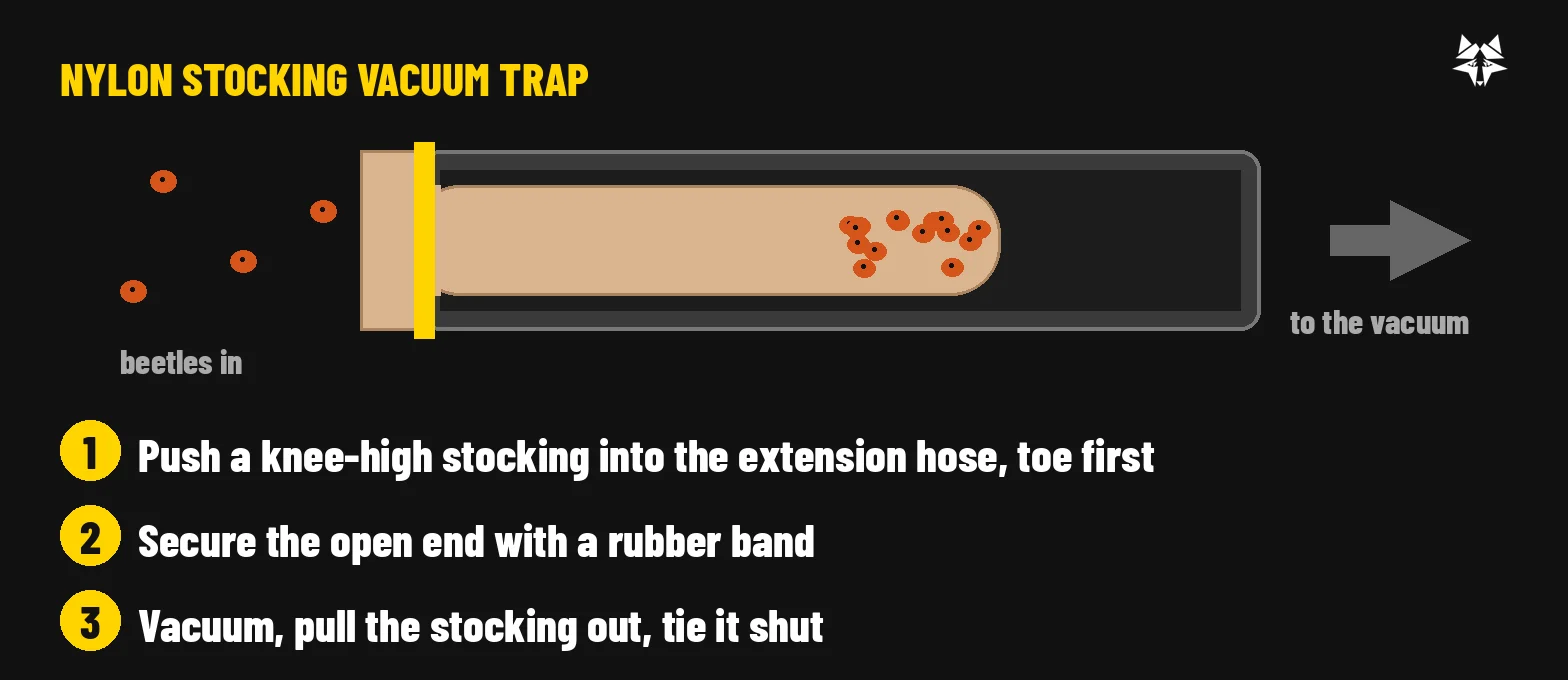
If your vacuum uses bags, change the bag after each session and tape and discard it or freeze it, because vacuumed beetles aren’t automatically killed and can crawl back out. The vacuum’s exhaust also blows their defensive odor around the room, so anyone allergic to lady beetles may not be able to do this job.
For a handful on a window, brush them gently into a cup. A broom is more likely to make them release the yellow fluid they use to defend themselves, and that fluid stains light surfaces. Don’t crush them on fabric or paint, since a squashed beetle can stain both.
How to kill the beetles you catch. Our practice is a quick physical kill, for beetles you’ve brushed into a cup or caught on a window. Tip one onto a hard surface, press it once and firmly with a folded paper towel, and put the towel in the outside trash. Do it away from fabric and painted surfaces. Freezing and soapy water are slower, according to a review of invertebrate euthanasia. A full vacuum bag or stocking is a bulk job, so tape the bag shut or tie off the stocking and put it in the outside trash.
Skip indoor light traps, which often give unsatisfactory results. Skip electric zappers too, which mostly kill other insects.
What If the Beetles Are Already in Your Walls?
Tens of thousands can pack into attics, ceilings, and wall voids. Heat leaking through the wall wakes them on a mild day, and they crawl toward the light, which is how a room you vacuumed on Monday has a fresh crowd on Thursday.
Spraying the cracks doesn’t help. It won’t stop the next beetles from coming out, and the dead ones can feed carpet beetles, which then go after wool and stored dry goods. Foggers don’t work either. They kill what’s on the ceiling and nothing that emerges after you air the room out. Attic foggers don’t reach beetles under insulation or inside walls either, and overusing them creates health and fire hazards.
The useful move is closing the exit. Beetles typically come out from behind baseboards, around window and door trim, and around exhaust fans and ceiling lights, and they can see light leaking through those cracks. Caulk them, starting in the room with the most beetles, and use tape as a stopgap. Sealing the inside doesn’t remove anyone from the wall, so expect to vacuum on and off through spring.
Expect a second wave in late winter. As the days warm, the beetles wake first on the sunnier, southwest side of the house and try to get outside, and some wander inward and come out behind baseboards, walls, and suspended ceilings. Many never find the way out and stay trapped inside. That’s why the pile on the sill keeps growing, and it’s why vacuuming works better than waiting.
Check inside your window air conditioners in fall and again in early spring. The openings are rarely screened, and beetles clog them.
Why Asian Lady Beetles Pick Your House
For an Asian lady beetle, your house is a good stand-in for a cliff.
In Japan, the beetles fly to south-facing rock cliffs and outcroppings in fall, and a sunny house wall seems to work the same way on them. In Pennsylvania they gather on the south and southwest sides on warm afternoons that follow cold nights, starting around early October. Buildings with dark and light contrast attract them, and buildings near woods get more than buildings in open country.
Once one beetle finds a good crevice, others follow. A pheromone, a chemical signal that draws the same species, may be behind it, along with droppings from the previous winter or the smell of beetles that died there.
They aren’t looking for food or a place to breed, so they don’t do either indoors. Every beetle you see inside in winter or spring came in the previous fall, and an individual can live up to three years.
How to Keep Asian Lady Beetles Out Next Fall
Sealing is the fix that lasts, and it isn’t perfect. It cuts the numbers rather than ending them, and the beetles fit through gaps of about 1/8 inch. Do the work in late spring or summer, before they start flying to buildings. Finish by mid-September. Beetles start showing up in late September in Minnesota, so earlier is safer.
Walk the south and west walls first. Check these spots.
- Window and door trim, and every seam where two materials meet, like brick and wood siding
- Fascia boards and soffits
- Pipes, cable lines, and outdoor faucets where they enter the house
- The bottoms of doors, which need sweeps or thresholds, plus a rubber seal on garage doors and foam weatherstripping under sliding doors
- Window and door screens, and the screens in roof vents, soffit vents, and bathroom and kitchen fans
- Window air conditioners, where the openings are rarely screened
- Firewood stacked against the house, which can carry them in
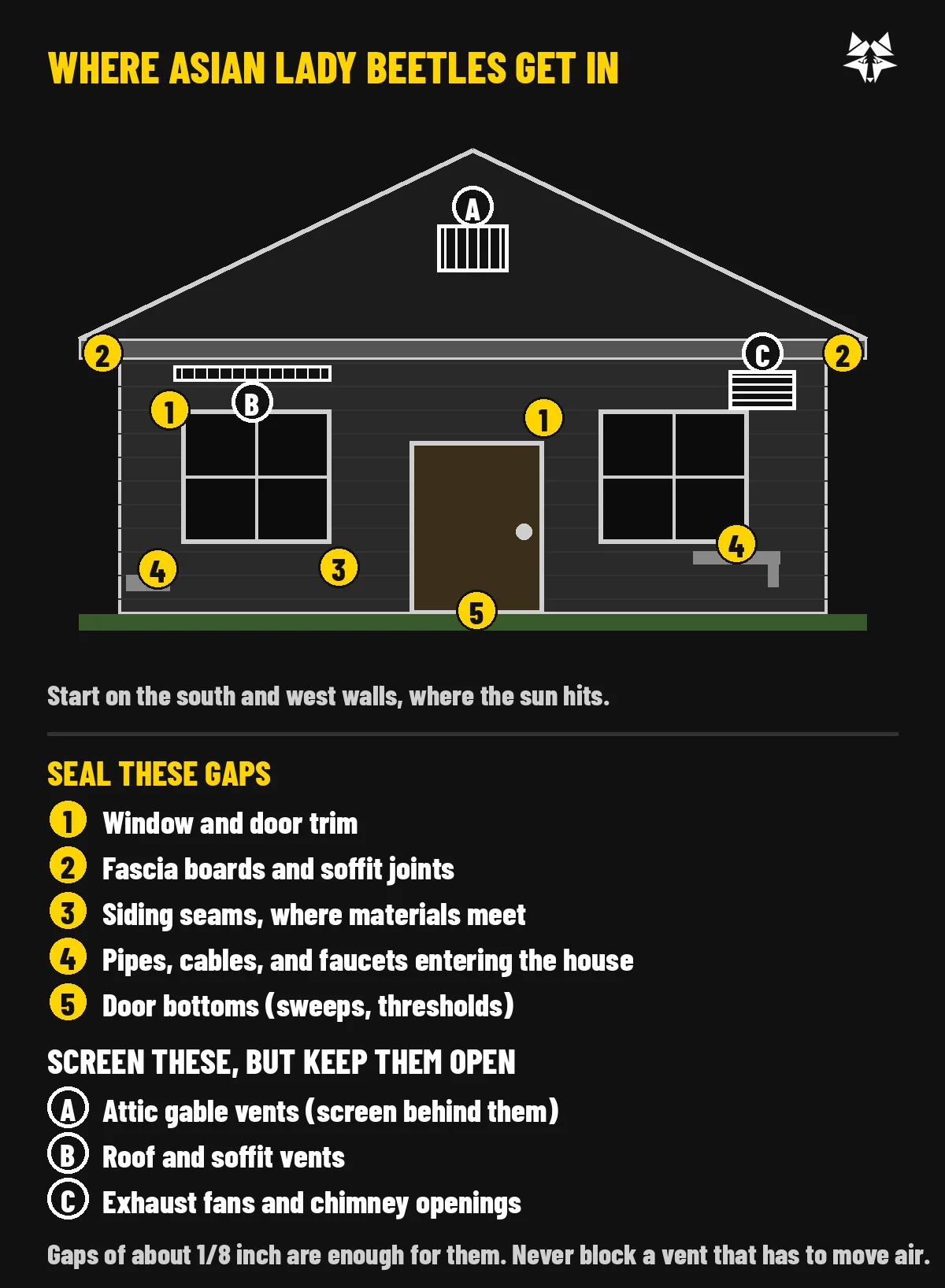
Silicone or silicone-latex caulk handles cracks. Copper mesh or expanding foam fills larger holes, and copper beats steel wool, which can rust and stain siding. Screen attic and exhaust openings with number 20 screen mesh, and never block a vent that has to move air.
Asian lady beetle calendar

Late spring and summer
Seal gaps, repair screens, and fit door sweeps, before the beetles start flying to buildings.
By mid-September
Finish sealing before mid-September.
Fall
Beetles gather on sunny south and west walls on warm afternoons. Pennsylvania sees this from early October, and Minnesota between late September and late October. Vacuum any that get in, and check window air conditioners.
Winter
Mild, sunny days wake beetles in the walls, and they head for windows. Vacuum them, and caulk the interior cracks they come out of.
Late winter and spring
Beetles wake first on the sunny southwest side and try to leave, and many stay trapped inside. Keep vacuuming, and check window air conditioners again.
Timing varies by region. Dates here come from extension pages in Pennsylvania, Minnesota, New Hampshire, and Kentucky.
Do Peppermint Oil, Vinegar, or Citrus Keep Them Away?
There are no repellents that make the beetles leave. Peppermint oil, citrus peels, vinegar, and bay leaves get passed around online, and none of them are listed as working by the extension pages we used.
Ladybug houses from garden catalogs won’t keep them out of your home either. Vacuum and seal instead.
How to Tell an Asian Lady Beetle From a Native Ladybug
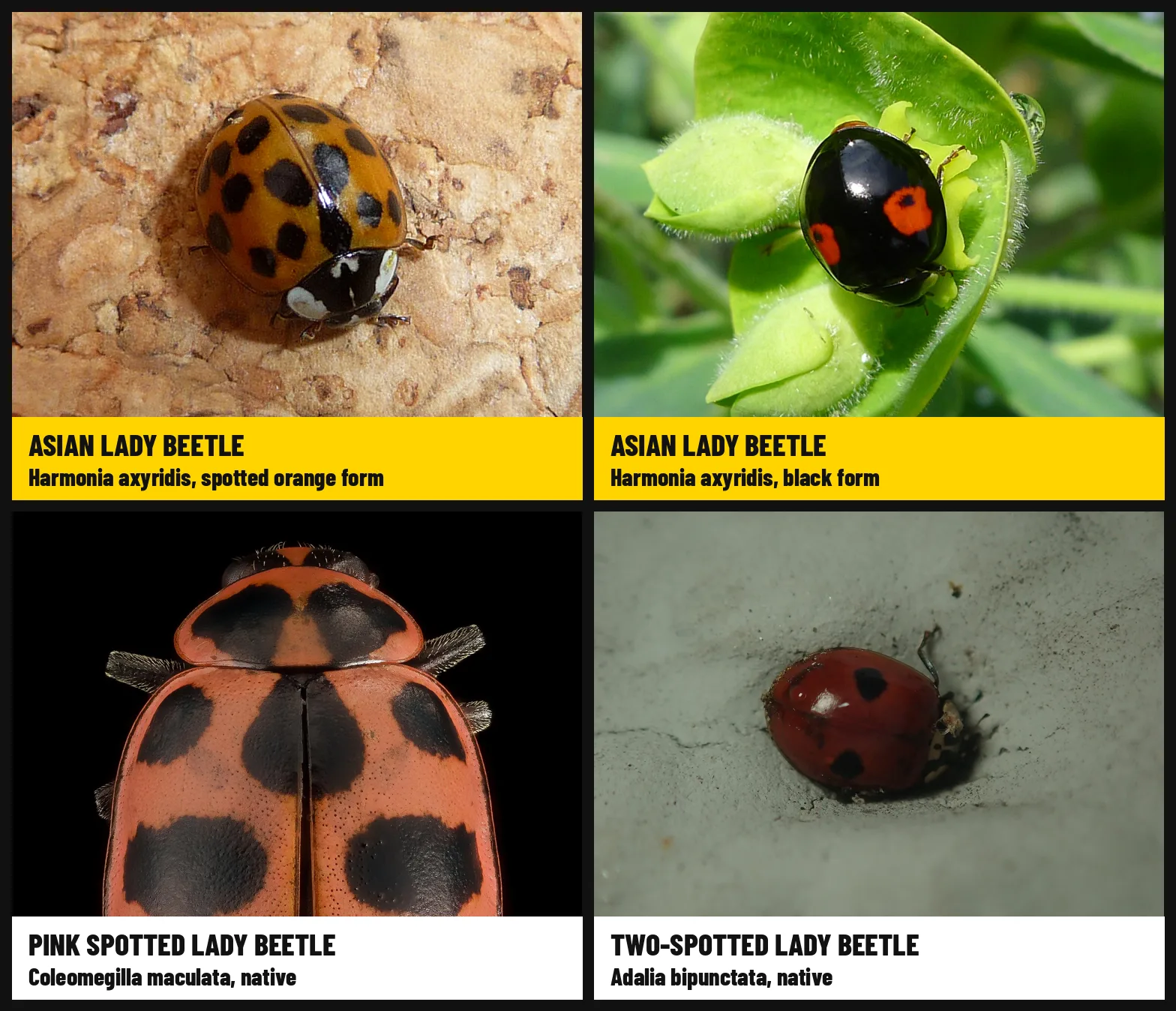
Asian lady beetles are real ladybugs. “Ladybug” and “lady beetle” cover the whole family, Coccinellidae, so the invader counts too. The giveaway is on the plate right behind the head, the pronotum. On an Asian lady beetle it’s white with a black M or W, and the mark can be thick, thin, broken, or filled in solid on dark beetles.
Color and spot count don’t settle it. They run from yellow-orange to red to black, with anywhere from no spots to 18 or 19, and they’re a quarter to a third of an inch long, bigger than most natives. A crowd on a sunny wall in fall is classic Asian lady beetle behavior, but check the marking before you decide.
Are Asian Lady Beetles Dangerous?
Asian lady beetles can’t sting, don’t carry disease that impact humans, and they don’t eat wood, fabric, or food. They do bite. Some bites break the skin and hurt briefly, and one extension sheet compares it to a pinprick. Their yellow defensive fluid smells bad and stains light surfaces.
Allergy is the real health issue. Eye and nose irritation, asthma, and facial swelling have all been linked to lady beetle infestations in homes, and some people who react to cockroaches cross-react to lady beetles. If you suspect a reaction, see a doctor, and don’t touch your eyes after handling them. Pets that eat them can get chemical burns inside the mouth, so call a vet if your dog or cat chews one.
Is It OK to Kill Asian Lady Beetles?
Yes. Asian lady beetles are an invasive species, and their spread has been linked to declines in a few native lady beetles. They were released on purpose for decades, starting in California in 1916, and none of those releases took. The ones here seem to descend from a batch that arrived by accident, probably on cargo, and turned up established in Louisiana in 1988. We found no study that tested whether removing them from homes helps native ladybugs, so killing the ones in your house may not make much difference to the natives, unfortunately.
A 24-year Michigan dataset found that only two native species, the two-spotted and pink spotted lady beetles, declined significantly, and each one’s decline varied with how much its diet overlapped with the invader’s. An 11-year study at four sites in England, where this beetle is called the harlequin ladybird, saw native ladybirds fall from 99.8 percent of those sampled to 30.7 percent, though only the two-spotted species declined significantly. The authors hypothesize that the invader preying on other ladybirds is an important driver.
The same beetle is one of the best aphid predators around. Larvae and adults eat aphids, and in orchards they can hold aphids below damaging levels. They also infest damaged fruit, and when a few get crushed with grapes at harvest they leave a taint that makes juice and wine unsellable.
So one insect is a pest in your attic, a predator in the orchard next door, and a competitor for some native ladybugs. Killing the ones in your house is an acceptable call, and what you control most is whether they overwinter there.
When to Call a Professional
Call someone when the same house fills every year, when the openings are on a roofline you can’t safely reach, or when someone at home has a real allergy. A pest control firm, a building contractor, or a painter can do the sealing. Ask for inspection and exclusion work, not a spray appointment. Some extension services list a professionally applied exterior insecticide band in late September for stubborn cases, but sealing is the better fix, and Kentucky’s sheet calls it the more permanent one.
Asian Lady Beetle FAQ
Will they leave on their own?
Some will in spring. They try to move outdoors, but many stay trapped inside.
How long do they live?
An individual can live up to three years.
Can they survive outside in winter?
Yes, in protected spots like leaf litter and under the bark of dead trees. Whether one dropped outside on a freezing day finds a spot like that is another question.
Will sealing my windows stop them?
It helps, but it won’t stop them alone. Gaps around siding, fascia, utility lines, and vents are all entry points, so check the whole outside of the house.
Sources
- Penn State Extension, Multicolored Asian Lady Beetle.
- University of Minnesota Extension, Multicolored Asian lady beetles.
- University of New Hampshire Extension, Multicolored Asian Ladybug.
- Cornell Integrated Pest Management, Multicolored Asian Lady Beetle.
- NC State Extension, Multicolored Asian Lady Beetle Inside Houses.
- Bahlai et al., Biological Invasions (2015), The role of exotic ladybeetles in the decline of native ladybeetle populations: evidence from long-term monitoring.
- Brown and Roy, Insect Conservation and Diversity (2018), Native ladybird decline caused by the invasive harlequin ladybird Harmonia axyridis: evidence from a long-term field study.
- University of Kentucky Entomology, Asian Lady Beetle Infestation of Structures (ENTFACT-416).
- Animals (2026), Euthanasia Methods in Invertebrates: A Critical Narrative Review of Methodological and Welfare Standards.