Why a Pet Opossum Almost Never Works Out, Even Where It’s Legal
- Give A Shit About Nature
- May 16, 2026
- Opossums, Wildlife
- 0 Comments
Can you keep a pet opossum? In most of the United States, no. Keeping a Virginia opossum as a pet is illegal in more than half the states, and no permit will change that. A smaller group allows it with a permit, and a short list of states, including Arkansas, Wisconsin, Idaho, and a handful of others, allows it with no state permit at all. Even there, your county or city can ban it anyway, and many do.
So the legal answer is “usually not, sometimes with paperwork, occasionally yes.” But that’s not really the question most people are asking. Most people typing this found a baby opossum, or are about to, and what they actually want to know is whether they can keep this one. That answer is clearer, and it has less to do with the law than you’d think.
The animal in the question is almost always a baby someone found
Nobody sets out to acquire an adult opossum. This search comes from a specific moment: a small opossum is alone in the yard, the mother is nowhere, maybe there’s a dead one by the road nearby, and the person standing there is deciding in real time whether to bring it inside.
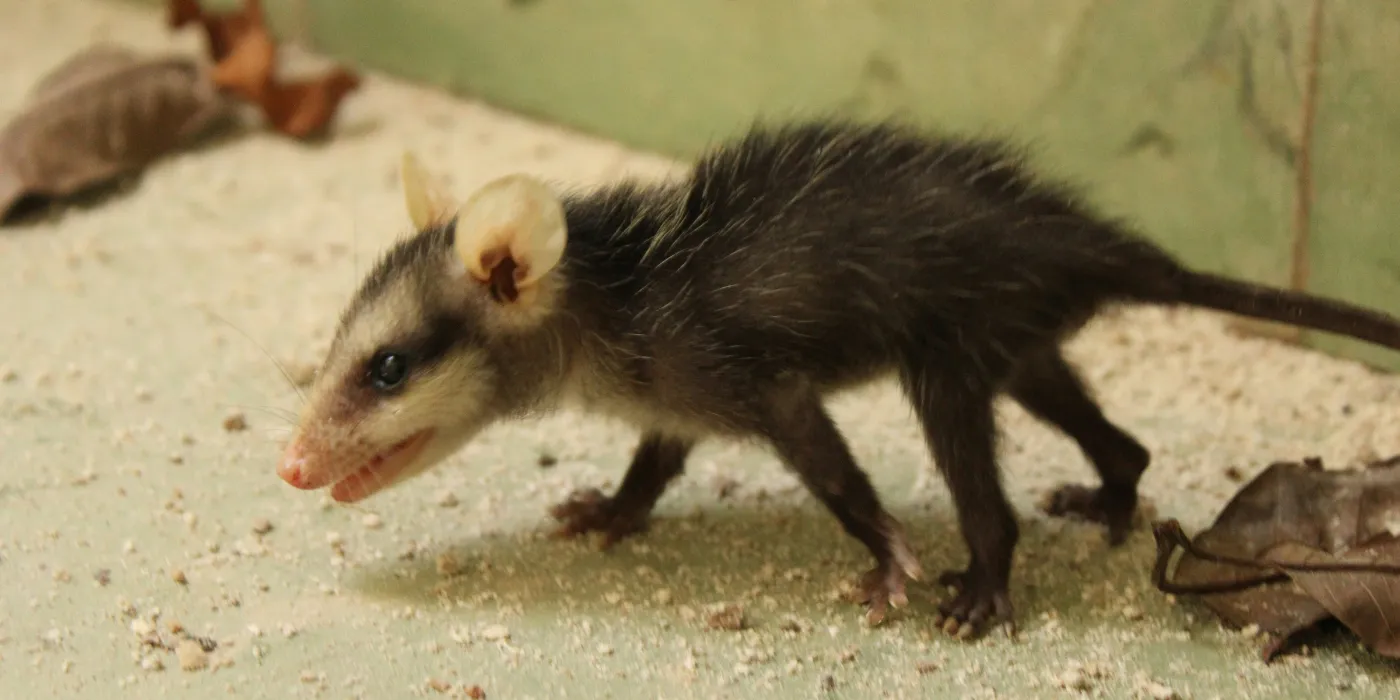
So start where the decision actually is. Measure the animal, nose to the base of the tail, tail not included. A body length of about seven inches is the line wildlife rehabilitators use. Over seven inches and healthy, it doesn’t need you at all. It’s independent, it fell off or wandered off the way young opossums do, and the kindest thing you can do is leave it alone. Opossum mothers don’t retrieve stragglers, and they’re not supposed to. A juvenile that sizes out on its own is the system working, not failing.
Under seven inches, it does need help, but not yours. It needs a licensed rehabilitator, and the gap between those two things is where most of the harm happens.
“I’ll just raise it myself” usually kills it
This is the part that’s hard to hear if you’ve already got the box ready.
A baby opossum’s dietary and temperature needs are extremely specific and change by the week. The wrong formula, or the right formula fed at the wrong temperature or angle, causes aspiration, diarrhea, and death, and it does so fast.
Cow’s milk will hurt them. So will human infant formula. The instinct to warm it and feed it, the two things that feel most like helping, are the two most common ways well-meaning people kill the animal they were trying to save.
It gets starker the smaller they are. A truly tiny, still-pink baby was living in a pouch that held it at a constant temperature like an incubator, attached to the mother around the clock. No rehabber can fully reproduce that, and pink babies have very low odds even in trained hands. If an expert with permits and equipment struggles to keep one alive, a first-timer with a heating pad and an internet recipe is not going to do better. That’s not a knock on anyone. It’s just what the animal is.
There’s also the part nobody pictures from the cute videos. An opossum doesn’t domesticate. It’s a wild animal with a one-to-two-year lifespan, it won’t reliably use a litter area, it eliminates wherever it is, and a hand-raised one bonds in a way that’s closer to dependency than affection.
The opossum in the snuggling clip is a stressed wild animal in a situation it can’t leave. What you’d actually be signing up for is a short-lived, messy, nocturnal animal with complex needs and no off-switch on its wildness, raised in a way that makes it worse at being an opossum.
Where it’s legal, and why legal still isn’t a good idea
For the cases where someone genuinely wants to know the law, here’s the honest shape of it.
A minority of states permit private opossum possession without a state permit. Arkansas is the clearest, explicitly allowing residents to keep certain native species, opossums included, though selling them or taking them across state lines is not allowed. Wisconsin exempts opossums from its wildlife licensing, provided the animal was obtained legally.
Others in this group are generally listed as Idaho, Illinois, Kansas, South Dakota, Utah, Wyoming, Delaware, and Florida, several of those with conditions like requiring a captive-bred source rather than a wild-caught animal.
Then a set of states allows it only with a permit, which in practice is often reserved for rehabbers and educators, not pet owners. And more than half of states, plus D.C., prohibit it outright, with California and Georgia among the firmest.
Be careful with the listicles on this, including the ones near the top of your search results. They disagree with each other, sometimes flatly, on the same state. That disagreement is the signal: this is genuinely a patchwork, it changes, and your county or HOA can be stricter than your state regardless.
The same is true for its closest cousin question, which we cover in Keeping a Pet Raccoon: The Legal Reality, State by State. If you’re seriously considering this, the only reliable answer comes from your state wildlife agency directly, not a ranked list.
But legal and advisable aren’t the same thing, and this is where the wildlife angle matters. Even in a no-permit state, the care problem doesn’t go away. A legal opossum is still a wild animal with a short life, specialized needs, and no real upside to captivity for the animal itself. The states that ban it mostly aren’t being arbitrary. They’re encoding the thing rehabbers will tell you for free.
What to actually do with the opossum in front of you
If it’s seven inches or longer and looks healthy, walk away. It’s fine. That’s not neglect, it’s the correct call.
If it’s smaller than that, injured, cold, crying nonstop, covered in what look like grains of rice (fly eggs), or it’s been in a cat’s or dog’s mouth, it needs a rehabilitator now. Anything that’s been in a cat’s mouth is an emergency even if it looks unhurt, because cat saliva carries bacteria that kills small wildlife without prompt antibiotics. While you’re arranging that:
- Put it in a secure box with a soft cloth. They climb well, so the lid has to be real.
- Low, indirect heat only, half the box on a heating pad on low so it can move off it.
- Dark, quiet, away from people and pets.
- No food, no water, not even a little, until a rehabilitator tells you otherwise. This single rule prevents a large share of the deaths.
One more thing worth knowing before you dispose of a “dead” one: playing possum is involuntary and can last up to four hours, complete with lolling tongue and foul green discharge. Give a motionless opossum real time before assuming the worst, and check a female’s pouch for live young if you can do it safely.
The honest version of “can I have a pet opossum” is that the person asking is usually a good person looking at a small animal that needs something. The thing it needs is a trained rehabilitator and, after that, to be a wild opossum.
Those are genuinely useful animals to have around your yard anyway, quietly working through ticks, slugs, carrion, and the occasional venomous snake. We make that case in full in Are Opossums Good to Have Around? Yes: Here’s Why, and what to do when you simply encounter one in What To Do If You See An Opossum.
Read More: Can You Keep A Wild Rabbit As A Pet?
FAQ
Is it illegal to keep a pet opossum? In most states, yes. More than half prohibit private possession of Virginia opossums outright, a middle group allows it only with a permit often limited to rehabbers, and a short list allows it with no state permit. Local governments and HOAs can be stricter than the state. Check directly with your state wildlife agency, since the online lists frequently contradict each other.
I found a baby opossum. Can I raise it? Almost certainly you shouldn’t, and in many states you legally can’t. If it’s seven inches or longer nose to rump and healthy, it’s independent and should be left alone. If it’s smaller or hurt, it needs a licensed rehabilitator. Home feeding is the leading way these babies die, because their dietary and temperature needs are very specific.
Do opossums make good pets even where it’s legal? Not really. They don’t domesticate, live only one to two years, won’t reliably use a litter area, and a hand-raised one forms dependency rather than the kind of bond people picture. Legal possession doesn’t change what the animal is or needs.
How do I know if a baby opossum is old enough to be on its own? Measure body length from the nose to the base of the tail, excluding the tail. Around seven inches is the rehabilitators’ benchmark for independence. Roughly the length of a dollar bill is a quick field check. Larger and alert means leave it; smaller or distressed means call a rehabilitator.
Why do states ban keeping opossums if they’re harmless? Bans are less about danger to people and more about the animal and the ecosystem: wild animals fare poorly in captivity, native wildlife is protected by state law, and casual possession undercuts both. Opossums are also low rabies risk and genuinely beneficial in the wild, which is the stronger argument for leaving them there.