Rarely, and almost always kittens or small cats. The International Owl Center says large owls do on rare occasions try to catch and kill small cats and very small dogs. Eating one is rare enough that a 2025 diet study called a single young cat a new record.
Gakona, Alaska is the case that shows both halves. In March 2013, a great horned owl there attacked a cat and at least two dogs over about four days. Several pet rabbits and another dog were found dead, and locals blamed the same bird.
The cat did fine. An owl had its talons in her, and her owner found one small scratch afterward. The owl’s run ended when a 15-pound terrier grabbed it by the neck.
So yes, it happens. The Alaska case also shows how strange it is when it does.
Are owls dangerous to cats?
Rarely. Pets aren’t a normal part of a great horned owl’s diet, but an animal outside at night can look like prey to a big generalist hunter.
Great horned owls are generalists. They have the most diverse diet of any North American raptor, from scorpions and mice to hares, skunks, geese, and other raptors. A cat in a yard is one more mid-sized mammal on a very long menu.
The U.S. Fish and Wildlife Service raptor specialist who weighed in on the Gakona attacks didn’t think it was normal owl behavior. If it were common, he said, it would be documented more often. An owl going after pets with people nearby “smacks of desperation,” and he suspected the bird was in poor shape or short on wild prey. Pet rabbits are the obvious first step, since owls eat hares in the wild, and then maybe something cat-sized.

What the diet studies show
Pellets answer the question better than anecdotes do. Owls cough up the bones and fur they can’t digest, and biologists count what’s in them.
In southwestern British Columbia, 546 prey items from seven sites were mostly Townsend’s voles (65.9 percent) and rats (13.1 percent), and the more urban the owl’s territory, the more rats it ate. At Mono Lake in California, pellets from two islands held deer mice, voles, rabbits, bats, gulls, insects, and an occasional owl. The Mono Lake list has no cat on it.
The cat turns up in a 2025 study of great horned owls in the northern Andes of Ecuador. Fifty-four pellets held 106 prey items, mostly opossums and black rats, and the authors also report a new record of predation on a young domestic cat. That’s a different subspecies on another continent, so it isn’t a North American number. What it shows is the pattern. Researchers flagged one kitten as a new record, which means it happens and it’s rare enough to publish.
The International Owl Center’s list of documented great horned owl foods includes house cats and very small dogs. The same list names the staples, which are hares, rabbits, mice, coots, and ducks.
Killing, eating, and carrying are different questions
Weight limits what an owl can carry. It doesn’t limit what an owl can kill. A great horned owl’s talons need 28 pounds of force to pry open, and the owl uses that grip to sever the spine of large prey. It takes skunks, and it can take geese, even though a Canada goose weighs up to 12 pounds.
So a small cat is killable. Eating one is documented and rare. The sources reviewed here don’t document an owl carrying off a full-grown cat. Cornell says even very small dogs may be too heavy for a hawk or owl to carry, and most cats weigh more than that.
Myths, ruled on
Great horned owls can carry four times their own weight. Myth. It appears in a Bangor Daily News outdoors column with no measurement behind it. The same column’s strongest evidence is owls killing geese, which is a kill and not a carry.
Owls can carry 9 pounds. Unproven. The number repeats across pet sites, including Birdzilla, and the same Birdzilla page says most cats are still too big for an owl to carry away.
Owls carry off cats. Not documented. PangoVet says it’s possible if the right owl attacks the right cat, then concedes most cats are too heavy to carry away. Alaska’s wildlife agency calls accounts of dogs being carried off far-fetched and impossible to verify.
Indoor cats aren’t safe. Myth. Catological says even indoor cats aren’t completely safe, but every case on this page involves a pet that was outside. The risk starts at the door.
Any big owl is a threat. Myth. Only the largest owls can handle a cat, which is covered next.
Which owls are a risk
In North America, that’s the great horned owl and the snowy owl. A snowy owl killed a one-year-old Yorkshire terrier in a backyard in St. Albert, Alberta, a case that a veteran owl rescuer called rare. In Eurasia and Africa, the biggest eagle-owls and fishing-owls are large enough to take a cat too.
The great gray owl looks like the biggest owl in the yard, and it isn’t the one to worry about. Voles make up almost 90 percent of its diet.
Which cats are at risk
Size decides most of it. A great horned owl weighs roughly 2 to 5.5 pounds. An average adult cat weighs 8 to 12 pounds, so most cats outweigh the bird that’s attacking them. The same specialist put it this way: great horned owls “look way bigger than they are actually built.”
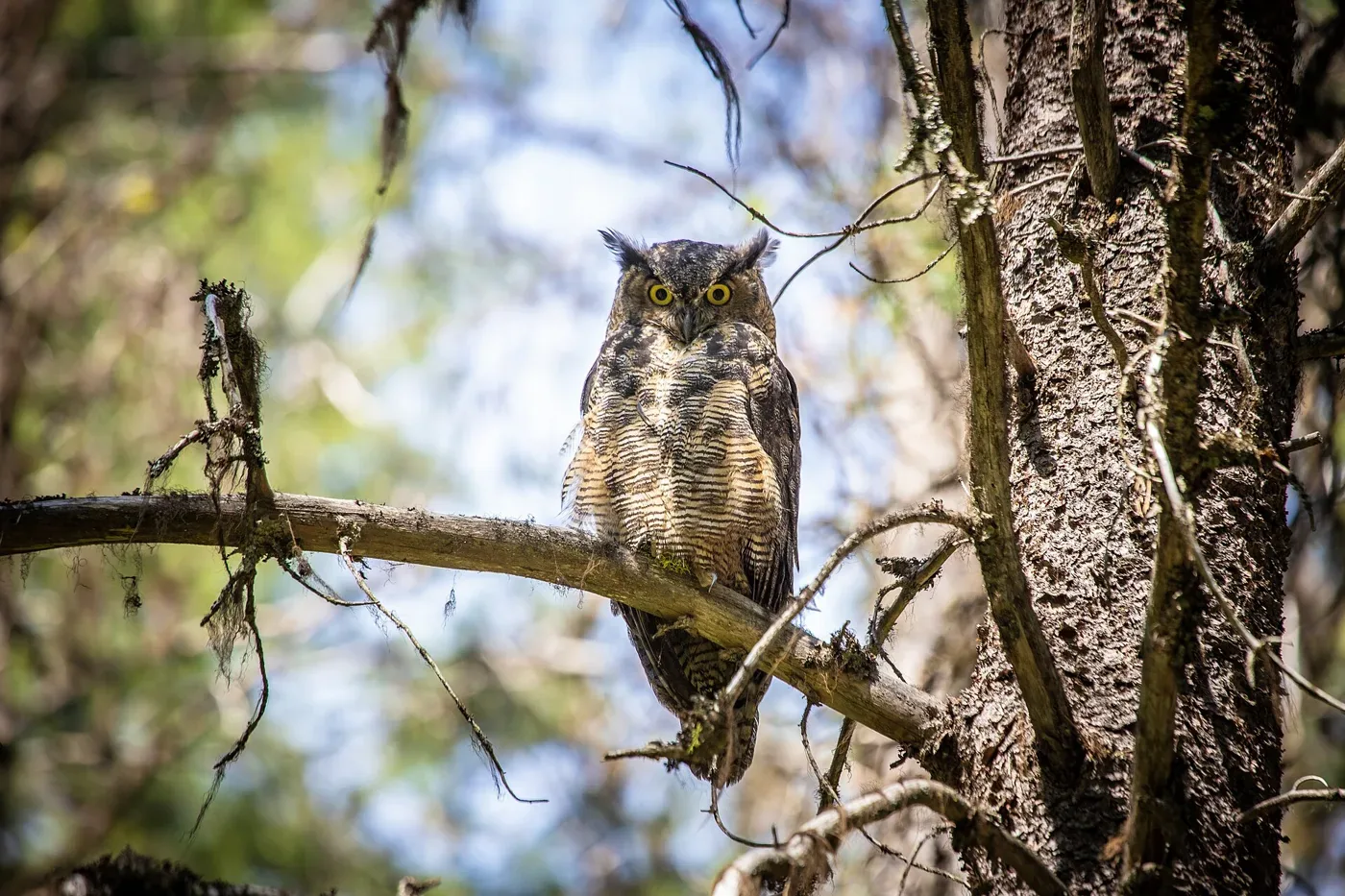
The International Owl Center’s line is at 5 pounds. It says cats and dogs that small shouldn’t be left outside unattended. The cats that fit the risk are
- Kittens.
- Small adult cats, around 5 pounds or less.
- Sick or weak cats, which a great horned owl might try for.
- Cats that can’t fight back. The Gakona owner credited her cat’s claws and thick fur.
Fighting back changes the math for the owl, too. The owl that picked the terrier lost.
What actually kills outdoor cats
Owls aren’t near the top. In a Chicago study that tracked free-roaming cats with radio collars, eight collared cats died. Three were apparently killed by coyotes, two were hit by cars, one died of disease, and two had unknown causes. None were attributed to owls. Eight is a small sample, but it matches what you’d expect. Cars and disease are the bigger risks.
Outdoor cats also tend to have shorter lives than indoor cats, with cars, antifreeze, and attacks by predators all on the list.
What to do about it
If owls hunt near you, keep cats inside at night and keep small cats and kittens supervised whenever they’re out. Great horned owls are most active at night, especially at dusk and before dawn, so the evening hours count too.
If your cat needs outdoor time, a sturdy, roofed catio gives them air and a view with a roof between them and the sky.
It helps the other side of the yard too. Free-ranging cats in the U.S. kill an estimated 1.3 to 4 billion birds a year, and our piece on common backyard bird hazards covers the rest. Cats also compete with owls for mice, shrews, and lizards, and can kill fledgling owls that can’t fly well yet.
If you’d rather have owls around than worry about them, we wrote up how to attract owls to your yard.
The owl’s side of this
An owl that takes a cat hasn’t developed a taste for pets. It’s a generalist hunter taking an opportunity, and the Alaska biologists suspected the bird itself was struggling.
Hunger may not be the whole story. Great horned owls are very early nesters, and in Interior Alaska egg laying and incubation can be well underway by March. Gakona’s attacks ran in March, and great horned owls defend their territories. That’s a possibility, not a conclusion.
Owls are also federally protected. The great horned owl is on the Migratory Bird Treaty Act list, so harming one or removing it from your property without a permit isn’t legal. That puts the changes on your side of the fence.
If you want owls around, and they do plenty of rodent control, the biggest favor you can do them is skip the rat poison. Poisoned rodents poison the owls that eat them, and we cover how in rodenticides and owls.
FAQ
Can an owl carry off a full-grown cat? The sources reviewed here don’t document an owl carrying off a full-grown cat. Alaska’s wildlife agency describes accounts of dogs being carried off as far-fetched and impossible to verify, and most adult cats weigh more than the owl.
Which owls can hurt a cat? Large ones. In North America that means the great horned owl, the species behind the Gakona attacks, and the snowy owl.
What should I do if an owl attacks my cat? Take the cat to a vet. Talon punctures look small from the outside, and the Alaska dogs that were hit had them around the neck and back, one right next to an eye.
Can I scare owls away from my yard? Not by harming them, since they’re federally protected. Changing your cat’s schedule is the legal fix, and it works.
Are owls dangerous to people? Rarely, but it can happen. We cover when and why in what to do if an owl attacks you.
Read next: How to Attract Owls to Your Yard: What Actually Works
Sources
- Alaska Department of Fish and Game, Alaska Fish & Wildlife News, May 2013, Great Horned Owl Attacks Pets.
- International Owl Center, Owls Attacking Pets.
- Cornell Lab of Ornithology, Great Horned Owl Life History.
- Cornell Lab of Ornithology, Great Horned Owl Identification.
- PetMD, What’s the Average Healthy Cat Weight?.
- Gehrt et al., PLOS ONE (2013), via PubMed Central, Population Ecology of Free-Roaming Cats and Interference Competition by Coyotes in Urban Parks.
- American Bird Conservancy, Keep Cats Indoors.
- Humane World for Animals, Catios: Safe Outdoor Enclosures for Happy, Healthy Cats.
- Loss, Will, and Marra, Nature Communications (2013), The impact of free-ranging domestic cats on wildlife of the United States.
- eCFR, 50 CFR 10.13, List of Birds Protected by the Migratory Bird Treaty Act.
- Cisneros-Heredia, Viteri-Basso, and Brito, bioRxiv (2025), Diet of the Great Horned Owl Bubo virginianus nigrescens in the Northern Andes of Ecuador.
- Hindmarch and Elliott, The Canadian Field-Naturalist (2015), Comparing the diet of Great Horned Owls in rural and urban areas of southwestern British Columbia.
- Aigner et al., Journal of Raptor Research (1994), via CalEcotox, Great horned owl food habits at Mono Lake, California.
- International Owl Center, Great Horned Owl Facts.
- Cornell Lab of Ornithology, Great Horned Owl Overview.
- Cornell Lab of Ornithology, Can a Hawk or Owl Pose a Threat to a Small Dog or Cat?.
- Bangor Daily News, Don’t underestimate the ferocity of the great horned owl.
- Birdzilla, Do Owls Eat Cats?.
- PangoVet, Do Owls Attack and Eat Cats?.
- Catological, Do Owls Attack And Eat Cats?.
- CBC News, Owl attack kills family dog in Alberta. 2011.
- National Park Service, Great Gray Owl.
- Denali Education Center, Great Horned Owls.
- Wikimedia Commons, Great Horned Owl (Bubo virginianus), photo by GlacierNPS, public domain.